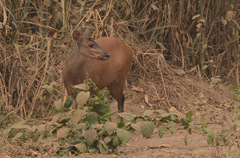
Red Brocket

Red Brocket

Mazama americana

Silhouette: Tracy A. Heath · PhyloPic

Daily sighting probability ~30% · Possible
at Brownsberg Nature Park

In 3 days ~70% in a week ~90%

5 Verified sightings at Brownsberg Nature Park From 2019 to 2026
65 In all 4 parks
October Best month
☀️🌙 Day & Night When it's spotted

About the Red Brocket

The red brocket (Mazama americana) is a species of brocket deer from forests in South America, ranging from northern Argentina to Colombia and the Guianas. It also occurs on the Caribbean island of Trinidad (it also occurred on the island of Tobago until very recent historical times, but has been extirpated there).

It formerly included the Central American red brocket (M. temama) and sometimes the Yucatan brown brocket (M. pandora) as subspecies. Considerable taxonomic confusion still exists for the populations remaining in the red brocket. Pending a solution to this, it has been evaluated as data deficient by the IUCN, though as presently defined, it is the most widespread species of brocket. It is sympatric with the smaller Amazonian brown brocket over much of its range (the latter tends to have significantly lower population densities). The karyotype of the red brocket was initially described as having 2n = 68, FN = 74, and more recently as having 2n varying from 48 to 54 and FN varying from 54 to 56. This variability may indicate the presence of unrecognized species in the population.

Its body is reddish-brown in color, with a lighter grayish-brown... Wikipedia →

Global Distribution

Parks Where Found

# Park Country Daily sighting probability
1 Brownsberg Nature Park 🇸🇷 Suriname
~30%
2 Yasuní National Park 🇪🇨 Ecuador
~20%
3 Manu National Park 🇵🇪 Peru
~20%
4 Tambopata National Reserve 🇵🇪 Peru
~20%

Zoos & Centres Where Found

# Zoo / Centre Country
1 Kadoorie Farm and Botanic Garden 🇭🇰 Hong Kong SAR China In captivity
2 Ukumarí Biopark 🇨🇴 Colombia In captivity
3 Bioparque Municipal Vesty Pakos 🇧🇴 Bolivia In captivity
4 Senda Verde (Wildlife Sanctuary) 🇧🇴 Bolivia In captivity
5 Parque de las Leyendas 🇵🇪 Peru In captivity
6 Bioparque Los Ocarros 🇨🇴 Colombia In captivity
7 Zoo. La Isla del Tapir 🇪🇨 Ecuador In captivity
8 Refugio Silvestre Yanacocha 🇪🇨 Ecuador In captivity
9 Yanacocha Animal Rescue Centre 🇪🇨 Ecuador In captivity
10 Barbados Wildlife Reserve 🇧🇧 Barbados In captivity
11 Emperor Valley Zoo 🇹🇹 Trinidad & Tobago In captivity
12 Agroflori Parque de las Aves 🇧🇴 Bolivia In captivity
13 Fundação Zoobotânica de Marabá 🇧🇷 Brazil In captivity
14 Wiwa Quito 🇪🇨 Ecuador In captivity

Before you go

What are the chances of seeing a Red Brocket in Brownsberg Nature Park?

Possible

About 30% of wildlife watchers report a Red Brocket sighting in Brownsberg Nature Park on a given day, based on 5 verified sightings from GBIF citizen-science data from 2019 to 2026. It is the 4th most-seen of the 5 mammals we can rate there. Over three days the chance rises to about 70%, and over a week to about 90%, if each day is a fresh chance.

When is the best time to see a Red Brocket in Brownsberg Nature Park?

October

In that month about 50% of wildlife watchers report a Red Brocket in Brownsberg Nature Park on a given day, against under 5% in March and November, the lowest months. That is one of Brownsberg Nature Park's driest months, with about 55 mm of rain against 490 mm in May. June and August–September have too few records to rate.

What time of day is best to see a Red Brocket?

Between 8 and 11 am

Across all the parks we cover, that three-hour window holds the most Red Brocket sightings with a recorded time, and about 7 in 10 of them come between 6 am and 6 pm: it is seen both by day and at night.

Is Brownsberg Nature Park the best place to see a Red Brocket?

Yes

Of the 4 parks where we can rate Red Brocket sightings, Brownsberg Nature Park has the highest daily chance: about 30%. Next come Yasuní National Park (Ecuador, about 20%) and Manu National Park (Peru, about 20%).

Where does the Red Brocket sighting chance come from?

GBIF citizen-science records

It is estimated from how often the Red Brocket is recorded against all the mammals logged in Brownsberg Nature Park (5 verified sightings from 2019 to 2026), calibrated against known sighting rates. Figures are rounded to the nearest 10% because citizen-science data supports honest approximations, not decimals, and months with records from fewer than five people show "—". How it works.

← Back to Brownsberg Nature Park