Northern Orange-legged Leaf Frog

Northern Orange-legged Leaf Frog

Pithecopus hypochondrialis

Silhouette: Robbi Bishop-Taylor · PhyloPic

LCLeast ConcernNTVUENCR
Daily sighting probability ~40% · Likely
at Brownsberg Nature Park

In 3 days ~80% in a week >90%

11 Verified sightings at Brownsberg Nature Park From 2019 to 2026
11 In 1 park
January Best month
🌙 Nocturnal When it's spotted

About the Northern Orange-legged Leaf Frog

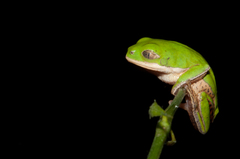
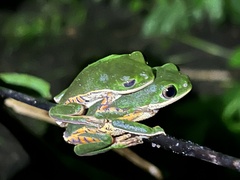
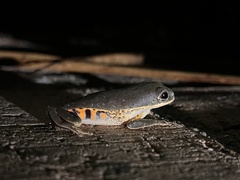
Pithecopus hypochondrialis, the northern orange-legged leaf frog or tiger-legged monkey frog, is a species of frog in the subfamily Phyllomedusinae found in South America. Its natural habitats are subtropical or tropical dry forests, subtropical or tropical moist lowland forests, subtropical or tropical moist shrubland, subtropical or tropical seasonally wet or flooded lowland grassland, intermittent freshwater marshes, pastureland, plantations, rural gardens, urban areas, and heavily degraded former forests. This frog has also been observed in cities. It has been observed as high as 1500 meters above sea level.

This frog is nocturnal and has been found perching shrubs and other plants in forests and in seasonally flooded grasslands. The male frog sits near a temporary pond and calls to the female frogs. The female frog lays eggs on leaves overhanging the water. The tadpoles fall into the water after they hatch.

P. hypochondrialis can use rapid color changes as camouflage to defend itself against predators. While still understudied, it has been shown that, in a nocturnal setting, dynamic color changing can be effective against avian predators when camouflaging into grass or leaf litter.

This frog can be affected by habitat loss given the deforestation associated with fire, agriculture, and cattle overgrazing. This frog has been sold as part of the international pet trade. But because this frog can live in cities, it is not in great danger of dying out. Wikipedia →

Sounds

Recording1:02

Suriname · 1968

© M.S. Hoogmoed · XC882836 · CC BY 4.0

Global Distribution

Parks Where Found

# Park Country Daily sighting probability
1 Brownsberg Nature Park 🇸🇷 Suriname
~40%

More parks will be added in future updates.

Before you go

What are the chances of seeing a Northern Orange-legged Leaf Frog in Brownsberg Nature Park?

Likely

About 40% of wildlife watchers report a Northern Orange-legged Leaf Frog sighting in Brownsberg Nature Park on a given day, based on 11 verified sightings from GBIF citizen-science data from 2019 to 2026. It is the 9th most-seen of the 18 amphibians we can rate there. Over three days the chance rises to about 80%, and over a week to over 90%, if each day is a fresh chance.

When is the best time to see a Northern Orange-legged Leaf Frog in Brownsberg Nature Park?

January

In that month about 70% of wildlife watchers report a Northern Orange-legged Leaf Frog in Brownsberg Nature Park on a given day, against under 5% in November, the lowest month. June and August–September have too few records to rate.

What time of day is best to see a Northern Orange-legged Leaf Frog?

Between 7 and 10 pm

Across all the parks we cover, that three-hour window holds the most Northern Orange-legged Leaf Frog sightings with a recorded time, and about 8 in 10 of them come between 6 pm and 6 am: it is mostly seen at night.

Where else can you see a Northern Orange-legged Leaf Frog?

Only Brownsberg Nature Park, in our data

Brownsberg Nature Park is the only park on Wallace's Line with enough records to rate Northern Orange-legged Leaf Frog sightings: about 40% of wildlife watchers there report one on a given day.

Where does the Northern Orange-legged Leaf Frog sighting chance come from?

GBIF citizen-science records

It is estimated from how often the Northern Orange-legged Leaf Frog is recorded against all the amphibians logged in Brownsberg Nature Park (11 verified sightings from 2019 to 2026), calibrated against known sighting rates. Figures are rounded to the nearest 10% because citizen-science data supports honest approximations, not decimals, and months with records from fewer than five people show "—". How it works.

← Back to Brownsberg Nature Park