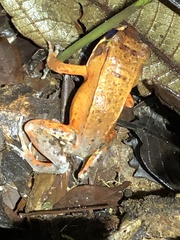
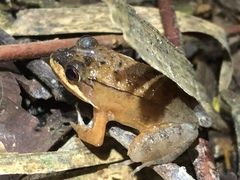
Loreto White-lipped Frog

Loreto White-lipped Frog

Leptodactylus rhodomystax

Silhouette: Jose Carlos Arenas-Monroy · PhyloPic

LCLeast ConcernNTVUENCR
Daily sighting probability ~40% · Likely
at Brownsberg Nature Park

In 3 days ~80% in a week >90%

8 Verified sightings at Brownsberg Nature Park From 2019 to 2026
67 In all 2 parks
February Best month
🌙 Nocturnal When it's spotted

About the Loreto White-lipped Frog

Leptodactylus rhodomystax (common name: Loreto white-lipped frog, rose-lipped thin-toed frog) is a species of frog in the family Leptodactylidae. It is found in the Guianas (French Guiana, Guyana, and Suriname) through northern and central Brazil to Amazonian Bolivia, Colombia, Peru, and Ecuador, and possibly in Venezuela where most if not all records represent misidentifications of Leptodactylus riveroi.

Leptodactylus rhodomystax are small frogs: the two syntypes measured 25 mm (0.98 in) in snout–vent length. Leptodactylus rhodomystax in found in leaf-litter on forest floor and in swamps in tropical rainforest as well as on the edges of clearings and in more open areas in forest. It breeds in semi-permanent waterbodies. Leptodactylus rhodomystax is not very choosy about breeding sites and uses many types of temporary and semi-permanent pools. Males call from within holes in the ground. They seem not to form choruses, and usually only one or few males can be heard calling at a particular site. Eggs are laid in foam nests. Wikipedia →

Sounds

Territorial call1:28

French Guiana · 2024

© Tristan Guillebot de Nerville · XC1147173 · CC BY-NC-SA 4.0

Advertisement call0:20

Ecuador · 2025

© Marc Anderson · XC1079582 · CC BY-NC-ND 4.0

Recording1:23

French Guiana · 1989

© M.S. Hoogmoed · XC882807 · CC BY 4.0

Global Distribution

Parks Where Found

# Park Country Daily sighting probability
1 Brownsberg Nature Park 🇸🇷 Suriname
~40%
2 Manu National Park 🇵🇪 Peru
~20%

Closest Relatives at Brownsberg Nature Park

Before you go

What are the chances of seeing a Loreto White-lipped Frog in Brownsberg Nature Park?

Likely

About 40% of wildlife watchers report a Loreto White-lipped Frog sighting in Brownsberg Nature Park on a given day, based on 8 verified sightings from GBIF citizen-science data from 2019 to 2026. It is the 12th most-seen of the 18 amphibians we can rate there. Over three days the chance rises to about 80%, and over a week to over 90%, if each day is a fresh chance.

When is the best time to see a Loreto White-lipped Frog in Brownsberg Nature Park?

February and July

In those months about 50% of wildlife watchers report a Loreto White-lipped Frog in Brownsberg Nature Park on a given day, against under 5% in November, the lowest month. June and August–September have too few records to rate.

What time of day is best to see a Loreto White-lipped Frog?

Between 8 and 11 pm

Across all the parks we cover, that three-hour window holds the most Loreto White-lipped Frog sightings with a recorded time, and about 9 in 10 of them come between 6 pm and 6 am: it is mostly seen at night.

Is Brownsberg Nature Park the best place to see a Loreto White-lipped Frog?

Yes

Of the 2 parks where we can rate Loreto White-lipped Frog sightings, Brownsberg Nature Park has the highest daily chance: about 40%. Next come Manu National Park (Peru, about 20%).

Which relatives of the Loreto White-lipped Frog live in Brownsberg Nature Park?

Same genus: Leptodactylus

The closest relatives of the Loreto White-lipped Frog that you can see in Brownsberg Nature Park (genus Leptodactylus, Neotropical Grass Frogs) are Knudsen's Thin-toed Frog (about 50%), Guiana White-lipped Frog (about 40%) and Smoky Jungle Frog (about 40%), with each one's daily chance of a sighting.

Where does the Loreto White-lipped Frog sighting chance come from?

GBIF citizen-science records

It is estimated from how often the Loreto White-lipped Frog is recorded against all the amphibians logged in Brownsberg Nature Park (8 verified sightings from 2019 to 2026), calibrated against known sighting rates. Figures are rounded to the nearest 10% because citizen-science data supports honest approximations, not decimals, and months with records from fewer than five people show "—". How it works.

← Back to Brownsberg Nature Park