Great Lakes Bush Viper

Great Lakes Bush Viper

Atheris nitschei

Silhouette: Steven Traver · PhyloPic

LCLeast ConcernNTVUENCR
Daily sighting probability ~20% · Possible
at Bwindi Impenetrable National Park

In 3 days ~50% in a week ~80%

8 Verified sightings at Bwindi Impenetrable National Park From 2019 to 2026
15 In all 2 parks
April Best month
☀️ Diurnal When it's spotted

About the Great Lakes Bush Viper

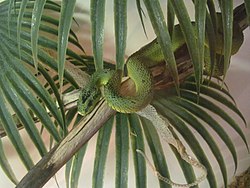
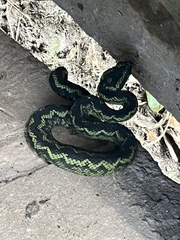
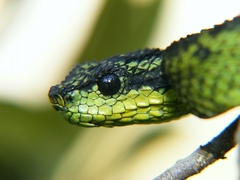
Common names: Great Lakes bush viper, Nitsche's bush viper, more. Atheris nitschei is a species of venomous snake, a viper in the subfamily Viperinae of the family Viperidae. The species is native to Africa. There are no subspecies that are recognized as being valid.

The former subspecies Atheris nitschei rungweensis from southwestern Tanzania, northeastern Zambia and northern Malawi was elevated to species rank as Atheris rungweensis. The specific name, nitschei, is in honor of German zoologist Hinrich Nitsche (1845–1902).

Atheris nitschei is a relatively large and stout bush viper, growing to an average total length (tail included) of 60 cm (24 in) and a maximum total length of at least 80 cm (31 in). The males are smaller than the females.

Common names for Atheris nitschei include Great Lakes bush viper, Nitsche's bush viper, black and green bush viper, Nitsche's tree viper. sedge viper, green viper, bush viper. Wikipedia →

Global Distribution

Parks Where Found

# Park Country Daily sighting probability
1 Nyungwe National Park 🇷🇼 Rwanda
~30%
2 Bwindi Impenetrable National Park 🇺🇬 Uganda
~20%

Zoos & Centres Where Found

# Zoo / Centre Country
1 Moscow Zoo 🇷🇺 Russia In captivity

Before you go

What are the chances of seeing a Great Lakes Bush Viper in Bwindi Impenetrable National Park?

Possible

About 20% of wildlife watchers report a Great Lakes Bush Viper sighting in Bwindi Impenetrable National Park on a given day, based on 8 verified sightings from GBIF citizen-science data from 2019 to 2026. It is the 5th most-seen of the 6 reptiles we can rate there. Over three days the chance rises to about 50%, and over a week to about 80%, if each day is a fresh chance.

When is the best time to see a Great Lakes Bush Viper in Bwindi Impenetrable National Park?

April

In that month about 40% of wildlife watchers report a Great Lakes Bush Viper in Bwindi Impenetrable National Park on a given day, against under 5% in May, August–September and November–March, the lowest months. That is one of Bwindi Impenetrable National Park's wettest months, with about 320 mm of rain against 65 mm in January.

What time of day is best to see a Great Lakes Bush Viper?

Between 9 am and noon

Across all the parks we cover, that three-hour window holds the most Great Lakes Bush Viper sightings with a recorded time, and about 8 in 10 of them come between 6 am and 6 pm: it is a daytime animal.

Is Bwindi Impenetrable National Park the best place to see a Great Lakes Bush Viper?

2nd of 2

Of the 2 parks where we can rate Great Lakes Bush Viper sightings, Bwindi Impenetrable National Park ranks 2nd at about 20%. The best odds are in Nyungwe National Park (Rwanda, about 30%).

Where does the Great Lakes Bush Viper sighting chance come from?

GBIF citizen-science records

It is estimated from how often the Great Lakes Bush Viper is recorded against all the reptiles logged in Bwindi Impenetrable National Park (8 verified sightings from 2019 to 2026), calibrated against known sighting rates. Figures are rounded to the nearest 10% because citizen-science data supports honest approximations, not decimals, and months with records from fewer than five people show "—". How it works.

← Back to Bwindi Impenetrable National Park