
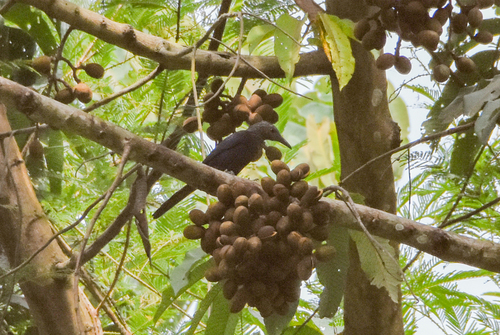
Stuhlmann's Starling

Stuhlmann's Starling

Poeoptera stuhlmanni

Silhouette: Rafael Maia · PhyloPic

LCLeast ConcernNTVUENCR
Daily sighting probability ~10% · With luck
at Bwindi Impenetrable National Park

In 3 days ~30% in a week ~50%

192 Verified sightings at Bwindi Impenetrable National Park From 2019 to 2026
393 In all 3 parks
February Best month
☀️ Diurnal When it's spotted

About the Stuhlmann's Starling

Stuhlmann's starling (Poeoptera stuhlmanni) is a species of starling in the family Sturnidae. It is native to the Albertine rift montane forests, the East African montane forests, the Imatong Mountains and the southwestern Ethiopian montane forests. Their length is usually around 19 cm, and they feed on seed, grain, arthropods and larvae. Fruits of the genus Ficus are also notable inclusions in their diet.

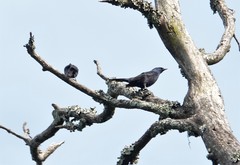
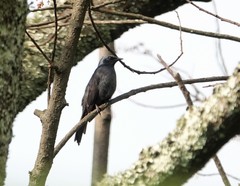
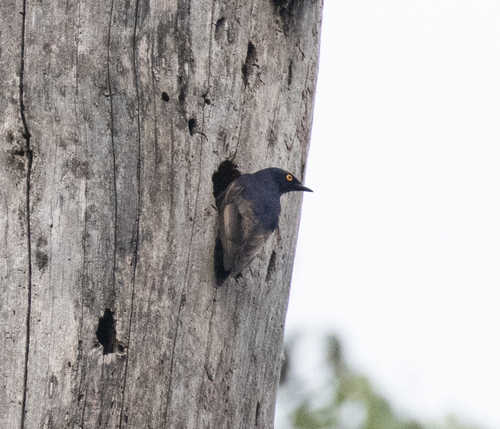
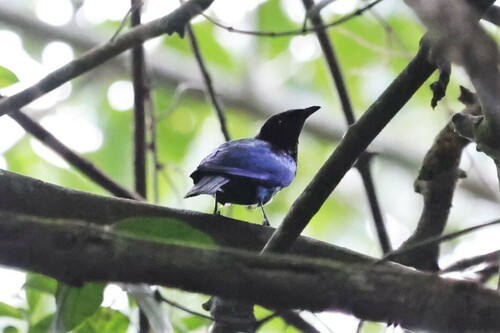
Stuhlmann's starling is a blue-black to blue-grey bird, with males appearing slightly darker and glossier on average than females. Female birds and subadults of both sexes have reddish markings on the undersides of the primary feathers. The eyes are typically a dark brown in adults, and both sexes have black bills and legs.

The calls include whistling, trilling, and "jay-like" sounds. Wikipedia →

Sounds

Call0:24

Kenya · 2024

© Peter Boesman · XC948404 · CC BY-NC-ND 4.0

Song0:29

Kenya · 2018

© Frank Lambert · XC451978 · CC BY-NC-ND 4.0

Call0:16

Kenya · 2016

© James Bradley · XC344767 · CC BY-NC-SA 4.0

Global Distribution

Parks Where Found

# Park Country Daily sighting probability
1 Nyungwe National Park 🇷🇼 Rwanda
~10%
2 Bwindi Impenetrable National Park 🇺🇬 Uganda
~10%
3 Kibale National Park 🇺🇬 Uganda
<5%

Before you go

What are the chances of seeing a Stuhlmann's Starling in Bwindi Impenetrable National Park?

With luck

About 10% of wildlife watchers report a Stuhlmann's Starling sighting in Bwindi Impenetrable National Park on a given day, based on 192 verified sightings from GBIF citizen-science data from 2019 to 2026. It is the 144th most-seen of the 400 birds we can rate there. Over three days the chance rises to about 30%, and over a week to about 50%, if each day is a fresh chance.

When is the best time to see a Stuhlmann's Starling in Bwindi Impenetrable National Park?

February

In that month about 20% of wildlife watchers report a Stuhlmann's Starling in Bwindi Impenetrable National Park on a given day, against under 5% in March–April and August, the lowest months. That is one of Bwindi Impenetrable National Park's driest months, with about 90 mm of rain against 320 mm in October.

What time of day is best to see a Stuhlmann's Starling?

Between 9 am and noon

Across all the parks we cover, that three-hour window holds the most Stuhlmann's Starling sightings with a recorded time, and about 9 in 10 of them come between 6 am and 6 pm: it is a daytime animal.

Is Bwindi Impenetrable National Park the best place to see a Stuhlmann's Starling?

Among the best

Of the 3 parks where we can rate Stuhlmann's Starling sightings, Bwindi Impenetrable National Park ranks 2nd at about 10%, level with the leaders once rounded. The best odds are in Nyungwe National Park (Rwanda, about 10%).

Which relatives of the Stuhlmann's Starling live in Bwindi Impenetrable National Park?

Same genus: Poeoptera

The closest relatives of the Stuhlmann's Starling that you can see in Bwindi Impenetrable National Park (genus Poeoptera, Poeoptera Starlings) are Narrow-tailed Starling (about 10%) and Sharpe's Starling (about 10%), with each one's daily chance of a sighting.

Where does the Stuhlmann's Starling sighting chance come from?

GBIF citizen-science records

It is estimated from how often the Stuhlmann's Starling is recorded against all the birds logged in Bwindi Impenetrable National Park (192 verified sightings from 2019 to 2026), calibrated against known sighting rates. Figures are rounded to the nearest 10% because citizen-science data supports honest approximations, not decimals, and months with records from fewer than five people show "—". How it works.

← Back to Bwindi Impenetrable National Park