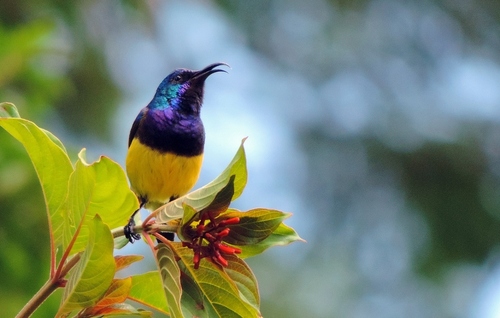
Tiny Sunbird

Tiny Sunbird

Cinnyris minullus

Silhouette: Sheatherius · PhyloPic

LCLeast ConcernNTVUENCR
Daily sighting probability <5% · Rare
at Bwindi Impenetrable National Park

In 3 days ~10% in a week ~30%

89 Verified sightings at Bwindi Impenetrable National Park From 2019 to 2026
98 In all 2 parks
July Best month
☀️ Diurnal When it's spotted

About the Tiny Sunbird

The tiny sunbird (Cinnyris minullus) is a species of bird in the family Nectariniidae. It is sparsely distributed across the African tropical rainforest. The tiny sunbird is the smallest species in the genus. The adult male has a metallic green head, back and throat, dark brown wings, a metallic blue rump and a black tail with a purplish-blue sheen. It has a narrow blue breast band above a wider scarlet breast band, lemon-yellow pectoral tufts and a dark olive belly. The adult female has an olive-brown head and upper parts, dark brown wings and dark brown tail. There is an olive-yellow supercilium over the eye, the throat is grey and the underparts are olive washed with yellow. The eyes in both sexes are dark brown and the beak and legs are black. The juvenile resembles the female.

The tiny sunbird is found in primary and secondary forests, forest edges, clearings and among scattered trees in savanna country and around villages. It forages in the canopy singly or in pairs, and sometimes joins small, mixed species flocks. It feeds on nectar, insects and spiders.

The tiny sunbird is described as a widespread species that is generally not uncommon... Wikipedia →

Sounds

Song0:10

Central African Republic · 2020

© Rod Cassidy · XC610084 · CC BY-NC-SA 4.0

Uncertain0:25

Gabon · 2021

© BurBenj · XC671647 · CC BY-NC-SA 4.0

Song0:29

Ghana · 2016

© Hans Matheve · XC352504 · CC BY-NC-ND 4.0

Global Distribution

Parks Where Found

# Park Country Daily sighting probability
1 Bwindi Impenetrable National Park 🇺🇬 Uganda
<5%
2 Kibale National Park 🇺🇬 Uganda
<5%

Before you go

What are the chances of seeing a Tiny Sunbird in Bwindi Impenetrable National Park?

Rare

Under 5% of wildlife watchers report a Tiny Sunbird sighting in Bwindi Impenetrable National Park on a given day, based on 89 verified sightings from GBIF citizen-science data from 2019 to 2026. It is the 206th most-seen of the 400 birds we can rate there. Over three days the chance rises to about 10%, and over a week to about 30%, if each day is a fresh chance.

When is the best time to see a Tiny Sunbird in Bwindi Impenetrable National Park?

March and June–July

In those months about 10% of wildlife watchers report a Tiny Sunbird in Bwindi Impenetrable National Park on a given day, against under 5% in April–May and August–February, the lowest months.

What time of day is best to see a Tiny Sunbird?

Between 7 and 10 am

Across all the parks we cover, that three-hour window holds the most Tiny Sunbird sightings with a recorded time, and about 8 in 10 of them come between 6 am and 6 pm: it is a daytime animal.

Is Bwindi Impenetrable National Park the best place to see a Tiny Sunbird?

Yes

Of the 2 parks where we can rate Tiny Sunbird sightings, Bwindi Impenetrable National Park has the highest daily chance: under 5%. Next come Kibale National Park (Uganda, under 5%).

Which relatives of the Tiny Sunbird live in Bwindi Impenetrable National Park?

Same genus: Cinnyris

The closest relatives of the Tiny Sunbird that you can see in Bwindi Impenetrable National Park (genus Cinnyris, Cinnyris Sunbirds) are Northern Double-collared Sunbird (about 60%), Regal Sunbird (about 30%) and Variable Sunbird (about 20%), with each one's daily chance of a sighting.

Where does the Tiny Sunbird sighting chance come from?

GBIF citizen-science records

It is estimated from how often the Tiny Sunbird is recorded against all the birds logged in Bwindi Impenetrable National Park (89 verified sightings from 2019 to 2026), calibrated against known sighting rates. Figures are rounded to the nearest 10% because citizen-science data supports honest approximations, not decimals, and months with records from fewer than five people show "—". How it works.

← Back to Bwindi Impenetrable National Park