
Tit-hylia

Tit-hylia

Pholidornis rushiae

Silhouette: Sheatherius · PhyloPic

LCLeast ConcernNTVUENCR
Daily sighting probability <5% · Rare
at Bwindi Impenetrable National Park

In 3 days <5%

10 Verified sightings at Bwindi Impenetrable National Park From 2019 to 2026
10 In 1 park
June Best month
☀️ Diurnal When it's spotted

About the Tit-hylia

The tit hylia (Pholidornis rushiae) is a species of bird, monotypic within the genus Pholidornis. It is found in rainforests in West and Central Africa. It had been placed in the family Cettiidae, but in 2019 its assignment to a new family, the Hyliidae, was strongly supported.

The tit hylia was described by John Cassin in 1855 as Diceum Rushiæ based on a specimen collected from present-day Gabon. It was placed in the genus Pholidornis by Gustav Hartlaub two years later. Its generic name is derived from the Ancient Greek pholidos for scale and ornis for bird.

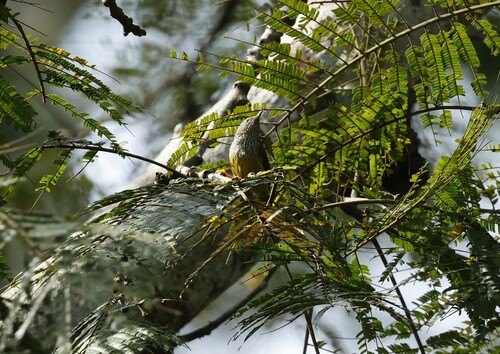
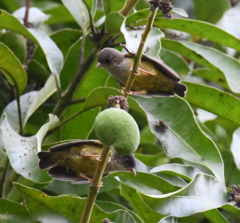
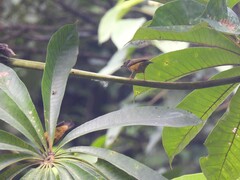
It is widespread across the African tropical rainforest. At 8 cm (3.1 in) long, it is perhaps the smallest bird native to Africa. This species has a pale buff chest and head overlaid with heavy brown streaking. From the lower breast down to the rump, this bird is bright yellow. The legs are a bright orange color. Juveniles are less colorful and less heavily streaked. Due to its small size it sometimes gets trapped in spider webs.

The tit hylia is a bird of the upper and middle canopy, usually foraging from 5–15 m (16–49 ft) from the forest... Wikipedia →

Sounds

Call1:08

Ghana · 2022

© Peter Boesman · XC719376 · CC BY-NC-ND 4.0

Call0:19

Ghana · 2010

© Mike Nelson · XC46254 · CC BY-NC-SA 3.0

Global Distribution

Parks Where Found

# Park Country Daily sighting probability
1 Bwindi Impenetrable National Park 🇺🇬 Uganda
<5%

More parks will be added in future updates.

Before you go

What are the chances of seeing a Tit-hylia in Bwindi Impenetrable National Park?

Rare

Under 5% of wildlife watchers report a Tit-hylia sighting in Bwindi Impenetrable National Park on a given day, based on 10 verified sightings from GBIF citizen-science data from 2019 to 2026. It is the 345th most-seen of the 400 birds we can rate there. Over three days the chance rises to under 5%, if each day is a fresh chance.

When is the best time to see a Tit-hylia in Bwindi Impenetrable National Park?

Any time of year

In every month with enough records, under 5% of wildlife watchers report a Tit-hylia in Bwindi Impenetrable National Park on a given day, so our monthly data shows no clear season.

What time of day is best to see a Tit-hylia?

Between 7 and 10 am

Across all the parks we cover, that three-hour window holds the most Tit-hylia sightings with a recorded time, and about 9 in 10 of them come between 6 am and 6 pm: it is a daytime animal.

Where else can you see a Tit-hylia?

Only Bwindi Impenetrable National Park, in our data

Bwindi Impenetrable National Park is the only park on Wallace's Line with enough records to rate Tit-hylia sightings: under 5% of wildlife watchers there report one on a given day.

Which relatives of the Tit-hylia live in Bwindi Impenetrable National Park?

Same family: Cettiidae

The closest relatives of the Tit-hylia that you can see in Bwindi Impenetrable National Park (family Cettiidae, Bush Warblers and Allies) are Green Hylia (about 20%), Grauer's Warbler (about 20%) and Neumann's Warbler (about 10%), with each one's daily chance of a sighting.

Where does the Tit-hylia sighting chance come from?

GBIF citizen-science records

It is estimated from how often the Tit-hylia is recorded against all the birds logged in Bwindi Impenetrable National Park (10 verified sightings from 2019 to 2026), calibrated against known sighting rates. Figures are rounded to the nearest 10% because citizen-science data supports honest approximations, not decimals, and months with records from fewer than five people show "—". How it works.

← Back to Bwindi Impenetrable National Park