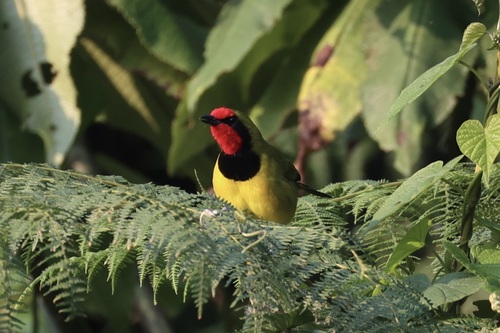
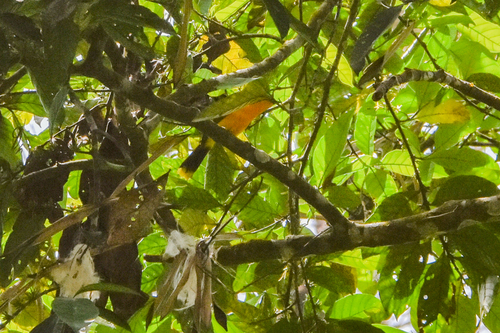
Willard's Sooty Boubou

Willard's Sooty Boubou

Laniarius willardi

Silhouette: Sheatherius · PhyloPic

Daily sighting probability <5% · Rare
at Bwindi Impenetrable National Park

In 3 days ~10% in a week ~30%

82 Verified sightings at Bwindi Impenetrable National Park From 2019 to 2026
277 In all 2 parks
June Best month

About the Willard's Sooty Boubou

Willard's sooty boubou (Laniarius willardi) is a species of bird in the family Malaconotidae, native to the Albertine Rift montane forests. The species was first described in 2010, based on five specimens, all collected by the Field Museum of Natural History and originally identified as the Mountain sooty boubou (L. poensis). Four were collected in 1997 on a private banana plantation in southern Uganda, and the fifth was collected in Burundi in 1991.

The species' main distinct trait is its gray-to-blue-gray eye color, in comparison to the reddish-black to black eye color typically found in the Mountain sooty boubou. However, specimens collected as far back as 1910 were identified as having gray irises, but categorized as L. poensis. The species was also identified as being genetically diagnosable, differing 11.5% in uncorrected sequence divergence from the co-located Albertine sooty boubou. The species is named in honor of Field Museum of Natural History collections manager David Willard, with its common name also reflecting its uniform black plumage.

The species is also considered to be potentially threatened, due to occurring in a narrow elevational band between... Wikipedia →


Sounds

Call0:37

Uganda · 2022

© Peter Boesman · XC739770 · CC BY-NC-ND 4.0

Alarm call1:13

Uganda · 2012

© Brian Cox · XC113291 · CC BY-NC-SA 3.0

Call0:21

Rwanda · 2014

© Pritam Baruah · XC194594 · CC BY-NC-SA 4.0

Global Distribution

Parks Where Found

# Park Country Daily sighting probability
1 Nyungwe National Park 🇷🇼 Rwanda
~10%
2 Bwindi Impenetrable National Park 🇺🇬 Uganda
<5%

Before you go

What are the chances of seeing a Willard's Sooty Boubou in Bwindi Impenetrable National Park?

Rare

Under 5% of wildlife watchers report a Willard's Sooty Boubou sighting in Bwindi Impenetrable National Park on a given day, based on 82 verified sightings from GBIF citizen-science data from 2019 to 2026. It is the 212th most-seen of the 400 birds we can rate there. Over three days the chance rises to about 10%, and over a week to about 30%, if each day is a fresh chance.

When is the best time to see a Willard's Sooty Boubou in Bwindi Impenetrable National Park?

February and June–July

In those months about 10% of wildlife watchers report a Willard's Sooty Boubou in Bwindi Impenetrable National Park on a given day, against under 5% in March–May and August–January, the lowest months. Those are among Bwindi Impenetrable National Park's driest months, with about 110 mm of rain a month against 320 mm in October.

Is Bwindi Impenetrable National Park the best place to see a Willard's Sooty Boubou?

2nd of 2

Of the 2 parks where we can rate Willard's Sooty Boubou sightings, Bwindi Impenetrable National Park ranks 2nd at under 5%. The best odds are in Nyungwe National Park (Rwanda, about 10%).

Which relatives of the Willard's Sooty Boubou live in Bwindi Impenetrable National Park?

Same genus: Laniarius

The closest relatives of the Willard's Sooty Boubou that you can see in Bwindi Impenetrable National Park (genus Laniarius, Boubous and Gonoleks) are Lühder's Bushshrike (about 50%), Western Boubou (about 10%) and Tropical Boubou (about 10%), with each one's daily chance of a sighting.

Where does the Willard's Sooty Boubou sighting chance come from?

GBIF citizen-science records

It is estimated from how often the Willard's Sooty Boubou is recorded against all the birds logged in Bwindi Impenetrable National Park (82 verified sightings from 2019 to 2026), calibrated against known sighting rates. Figures are rounded to the nearest 10% because citizen-science data supports honest approximations, not decimals, and months with records from fewer than five people show "—". How it works.

← Back to Bwindi Impenetrable National Park