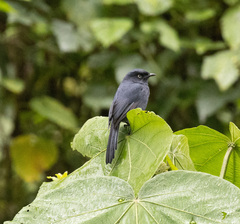
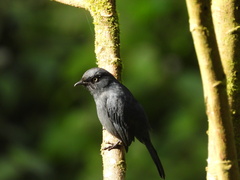
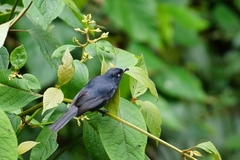
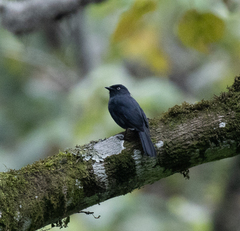
Yellow-eyed Black-Flycatcher

Yellow-eyed Black-Flycatcher

Melaenornis ardesiacus

Silhouette: Martin Bulla, based on François Desbordes' illustration · PhyloPic

LCLeast ConcernNTVUENCR
Daily sighting probability ~20% · Possible
at Bwindi Impenetrable National Park

In 3 days ~40% in a week ~70%

335 Verified sightings at Bwindi Impenetrable National Park From 2019 to 2026
659 In all 2 parks
October Best month
☀️ Diurnal When it's spotted

About the Yellow-eyed Black-Flycatcher

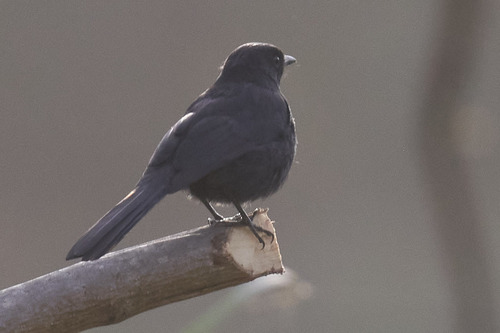
The yellow-eyed black flycatcher (Melaenornis ardesiacus) is a small passerine bird of the genus Melaenornis in the flycatcher family Muscicapidae native to the Albertine Rift montane forests. The chin, lores and forehead are blackish, the rest of the plumage is a deep blue-grey. It differs from the Northern black flycatcher and Southern black flycatcher by having pale eyes. The sexes are similar.

The juvenile has whitish spots on the breast. The immature is not properly described. This species is found in the African Rift Valley from southern Uganda to northern Tanzania. It is generally found at an altitude of 1300-2450 metres. They occupy edges of forests and forest clearings. This species mainly eats caterpillars of butterflies and moths and beetles.

Calls have been recorded as raap, raap and a harsh tch-tchec. This species breeds from January to April in the Democratic Republic of the Congo. It is monogamous and territorial. It builds a cup-shaped nest made of moss and small fibers, placed on the forks of tree branches about 4-5 meters in height.

The clutch size of this species is 2. No information... Wikipedia →

Sounds

Call1:29

Uganda · 2022

© Peter Boesman · XC739805 · CC BY-NC-ND 4.0

Call0:18

Uganda · 2018

© Bram Vogels · XC430386 · CC BY-NC-SA 4.0

Call1:07

Uganda · 2005

© András Schmidt · XC700674 · CC BY-NC-SA 4.0

Global Distribution

Parks Where Found

# Park Country Daily sighting probability
1 Nyungwe National Park 🇷🇼 Rwanda
~20%
2 Bwindi Impenetrable National Park 🇺🇬 Uganda
~20%

Before you go

What are the chances of seeing a Yellow-eyed Black-Flycatcher in Bwindi Impenetrable National Park?

Possible

About 20% of wildlife watchers report a Yellow-eyed Black-Flycatcher sighting in Bwindi Impenetrable National Park on a given day, based on 335 verified sightings from GBIF citizen-science data from 2019 to 2026. It is the 98th most-seen of the 400 birds we can rate there. Over three days the chance rises to about 40%, and over a week to about 70%, if each day is a fresh chance.

When is the best time to see a Yellow-eyed Black-Flycatcher in Bwindi Impenetrable National Park?

October

In that month about 30% of wildlife watchers report a Yellow-eyed Black-Flycatcher in Bwindi Impenetrable National Park on a given day, against about 10% in February–April, June, September and November–December, the lowest months. That is one of Bwindi Impenetrable National Park's wettest months, with about 320 mm of rain against 65 mm in January.

What time of day is best to see a Yellow-eyed Black-Flycatcher?

Between 7 and 10 am

Across all the parks we cover, that three-hour window holds the most Yellow-eyed Black-Flycatcher sightings with a recorded time, and about 9 in 10 of them come between 6 am and 6 pm: it is a daytime animal.

Is Bwindi Impenetrable National Park the best place to see a Yellow-eyed Black-Flycatcher?

Among the best

Of the 2 parks where we can rate Yellow-eyed Black-Flycatcher sightings, Bwindi Impenetrable National Park ranks 2nd at about 20%, level with the leaders once rounded. The best odds are in Nyungwe National Park (Rwanda, about 20%).

Where does the Yellow-eyed Black-Flycatcher sighting chance come from?

GBIF citizen-science records

It is estimated from how often the Yellow-eyed Black-Flycatcher is recorded against all the birds logged in Bwindi Impenetrable National Park (335 verified sightings from 2019 to 2026), calibrated against known sighting rates. Figures are rounded to the nearest 10% because citizen-science data supports honest approximations, not decimals, and months with records from fewer than five people show "—". How it works.

← Back to Bwindi Impenetrable National Park