Creaser's Mud Turtle

Creaser's Mud Turtle

Kinosternon creaseri

Silhouette: Jose Carlos Arenas-Monroy · PhyloPic

LCNTNear ThreatenedVUENCR Endemic
Daily sighting probability ~10% · With luck
at Calakmul Biosphere Reserve

In 3 days ~30% in a week ~50%

6 Verified sightings at Calakmul Biosphere Reserve From 2019 to 2026
6 In 1 park
October Best month
☀️ Diurnal When it's spotted

About the Creaser's Mud Turtle

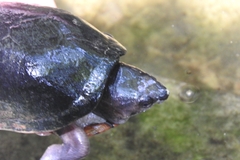
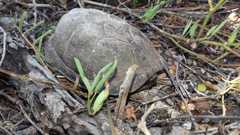
Creaser's mud turtle (Kinosternon creaseri) is a species of mud turtle in the family Kinosternidae. The species is endemic to the Yucatán Peninsula in southeastern Mexico. The specific name, creaseri, is in honor of American zoologist Edwin Phillip Creaser (1907–1981).

K. creaseri is found in the Mexican states of Campeche, Quintana Roo, and Yucatan. A 1988 study found that the densest population occurred in Quintana Roo, as the state had been subjected to less deforestation than Campeche or Yucatán.

The preferred natural habitat of K. creaseri is small temporary pools of water in forests, shrubland, and freshwater wetlands, although they may occasionally be found in permanent pools of water as well. These temporary pools of water are generally devoid of fish.

The species is of average size for the genus Kinosternon. Males are slightly larger than females. The average carapace length of males is 11.5 cm, while female average carapace length is 10.7 cm. The largest male on record had a carapace length of 12.5 cm. Males can also be distinguished from females by their longer tails.

The species can be identified by its distinctive,... Wikipedia →

Global Distribution

Parks Where Found

# Park Country Daily sighting probability
1 Calakmul Biosphere Reserve 🇲🇽 Mexico
~10%

More parks will be added in future updates.

Zoos & Centres Where Found

# Zoo / Centre Country
1 Zoológico La Reina 🇲🇽 Mexico In captivity

Before you go

What are the chances of seeing a Creaser's Mud Turtle in Calakmul Biosphere Reserve?

With luck

About 10% of wildlife watchers report a Creaser's Mud Turtle sighting in Calakmul Biosphere Reserve on a given day, based on 6 verified sightings from GBIF citizen-science data from 2019 to 2026. It is the 35th most-seen of the 46 reptiles we can rate there. Over three days the chance rises to about 30%, and over a week to about 50%, if each day is a fresh chance.

When is the best time to see a Creaser's Mud Turtle in Calakmul Biosphere Reserve?

October

In that month about 30% of wildlife watchers report a Creaser's Mud Turtle in Calakmul Biosphere Reserve on a given day, against under 5% in August and November–May, the lowest months. That is one of Calakmul Biosphere Reserve's wettest months, with about 120 mm of rain against 15 mm in February.

What time of day is best to see a Creaser's Mud Turtle?

Between 7 and 10 am

Across all the parks we cover, that three-hour window holds the most Creaser's Mud Turtle sightings with a recorded time, and about 8 in 10 of them come between 6 am and 6 pm: it is a daytime animal.

Where else can you see a Creaser's Mud Turtle?

Only Calakmul Biosphere Reserve, in our data

Calakmul Biosphere Reserve is the only park on Wallace's Line with enough records to rate Creaser's Mud Turtle sightings: about 10% of wildlife watchers there report one on a given day.

Which relatives of the Creaser's Mud Turtle live in Calakmul Biosphere Reserve?

Same genus: Kinosternon

The closest relatives of the Creaser's Mud Turtle that you can see in Calakmul Biosphere Reserve (genus Kinosternon, Mud Turtles) are Scorpion Mud Turtle (about 10%), White-lipped Mud Turtle (about 10%) and Tabasco Mud Turtle (about 10%), with each one's daily chance of a sighting.

Where does the Creaser's Mud Turtle sighting chance come from?

GBIF citizen-science records

It is estimated from how often the Creaser's Mud Turtle is recorded against all the reptiles logged in Calakmul Biosphere Reserve (6 verified sightings from 2019 to 2026), calibrated against known sighting rates. Figures are rounded to the nearest 10% because citizen-science data supports honest approximations, not decimals, and months with records from fewer than five people show "—". How it works.

← Back to Calakmul Biosphere Reserve