Brown's Coralsnake

Brown's Coralsnake

Micrurus browni

Silhouette: Edwin Price · PhyloPic

LCLeast ConcernNTVUENCR
Daily sighting probability ~10% · With luck
at Cañón del Sumidero National Park

In 3 days ~30% in a week ~50%

5 Verified sightings at Cañón del Sumidero National Park From 2019 to 2026
5 In 1 park
October Best month
☀️ Diurnal When it's spotted

About the Brown's Coralsnake

Micrurus browni, commonly known as Brown's coral snake, is a species of venomous snake in the family Elapidae. The species is native to Guatemala and southwestern Mexico. There are three recognized subspecies, including the nominate subspecies described here.

The specific name, browni, is in honor of American scientific collector Wilmot W. Brown Jr. Common names for Micrurus browni in Spanish include serpiente-coralillo de Brown, coral, coral de Acapulco, coral de Antigua, coral (or coralillo) de canutos, and vibora de coral.

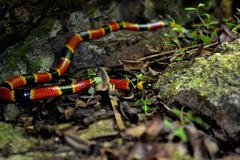
Brown's coral snake can grow to 100 cm (39 in) in total length (tail included), but it is usually 50 cm (20 in) to 70 cm (28 in). It has smooth dorsal scales, a rounded head, and the pupil of the eye is round. Its color pattern is three-colored: broad red rings, separated by 10–27 black rings, each black ring bordered by two narrow yellow rings. The snout is black. There is usually a yellow band, across the top of the head, halfway back.

The geographic distribution of Micrurus browni is limited to Quintana Roo in southwestern Mexico, and western Guatemala, including Sacatepéquez... Wikipedia →

Global Distribution

Parks Where Found

# Park Country Daily sighting probability
1 Cañón del Sumidero National Park 🇲🇽 Mexico
~10%

More parks will be added in future updates.

Zoos & Centres Where Found

# Zoo / Centre Country
1 Zoológico Miguél Álvarez del Toro 🇲🇽 Mexico In captivity

Before you go

What are the chances of seeing a Brown's Coralsnake in Cañón del Sumidero National Park?

With luck

About 10% of wildlife watchers report a Brown's Coralsnake sighting in Cañón del Sumidero National Park on a given day, based on 5 verified sightings from GBIF citizen-science data from 2019 to 2026. It is the 10th most-seen of the 10 reptiles we can rate there. Over three days the chance rises to about 30%, and over a week to about 50%, if each day is a fresh chance.

When is the best time to see a Brown's Coralsnake in Cañón del Sumidero National Park?

August and October–November

In those months about 20% of wildlife watchers report a Brown's Coralsnake in Cañón del Sumidero National Park on a given day, against under 5% in May–July, September and December–March, the lowest months.

What time of day is best to see a Brown's Coralsnake?

Between 9 am and noon

Across all the parks we cover, that three-hour window holds the most Brown's Coralsnake sightings with a recorded time, and about 7 in 10 of them come between 6 am and 6 pm: it is a daytime animal.

Where else can you see a Brown's Coralsnake?

Only Cañón del Sumidero National Park, in our data

Cañón del Sumidero National Park is the only park on Wallace's Line with enough records to rate Brown's Coralsnake sightings: about 10% of wildlife watchers there report one on a given day.

Where does the Brown's Coralsnake sighting chance come from?

GBIF citizen-science records

It is estimated from how often the Brown's Coralsnake is recorded against all the reptiles logged in Cañón del Sumidero National Park (5 verified sightings from 2019 to 2026), calibrated against known sighting rates. Figures are rounded to the nearest 10% because citizen-science data supports honest approximations, not decimals, and months with records from fewer than five people show "—". How it works.

← Back to Cañón del Sumidero National Park