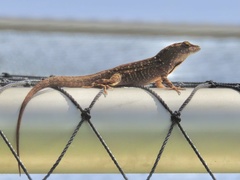
Brown Anole

Brown Anole

Anolis sagrei

Silhouette: Beth Reinke · PhyloPic

LCLeast ConcernNTVUENCR
Daily sighting probability ~10% · With luck
at Cañón del Sumidero National Park

In 3 days ~30% in a week ~60%

8 Verified sightings at Cañón del Sumidero National Park From 2019 to 2026
3,689 In all 13 parks
May Best month
☀️ Diurnal When it's spotted

About the Brown Anole

The brown anole (Anolis sagrei), also known commonly as the Bahaman anole, Cuban brown anole, and de la Sagra's anole, is a species of lizard in the family Anolidae. The species is native to Cuba, the Bahamas, Little Cayman, Cayman Brac, Jamaica, the Swan Islands, the Yucatán Peninsula, Belize, and the Caribbean coast of Guatemala and Honduras. It has been widely introduced elsewhere, via the importation and exportation of plants in pots in which brown anoles laid eggs in the soil, and is now found in Florida and other regions of the United States including southern Georgia, Texas, Louisiana, Tennessee, Mississippi, Alabama, Hawaii, North Carolina, and Southern California. It has also been introduced to other Caribbean islands, Mexico, Singapore, and Taiwan.

This species is highly invasive. It is also much more wary of humans than most other anole species. In its introduced range, it reaches exceptionally high population densities, is capable of expanding its range very quickly, and both outcompetes and consumes many species of native lizards, like the green anole. The brown anole's introduction into the United States in the early 1970s has altered the behavior and negatively affected populations of the native Carolina anole (Anolis carolinensis, also known as the green anole), which has since generally been relegated to the treetops. Wikipedia →

Sounds

Recording0:16

United States · 2023

© The_cool_moth · iNaturalist · CC BY-NC 4.0

Global Distribution

Parks Where Found

# Park Country Daily sighting probability
1 Everglades National Park 🇺🇸 United States
~70%
2 Big Cypress National Preserve 🇺🇸 United States
~70%
3 Arrecifes de Cozumel National Park 🇲🇽 Mexico
~60%
4 Merritt Island National Wildlife Refuge 🇺🇸 United States
~60%
5 Ciénaga de Zapata 🇨🇺 Cuba
~30%
6 Sian Ka'an Biosphere Reserve 🇲🇽 Mexico
~30%
7 Chagres National Park 🇵🇦 Panama
~20%
8 Parque Natural Metropolitano 🇵🇦 Panama
~20%
9 Ría Lagartos Biosphere Reserve 🇲🇽 Mexico
~20%
10 Celestún Biosphere Reserve 🇲🇽 Mexico
~20%
11 Calakmul Biosphere Reserve 🇲🇽 Mexico
~10%
12 Cañón del Sumidero National Park 🇲🇽 Mexico
~10%
13 Soberanía National Park 🇵🇦 Panama
~10%

Cities Where Found

# City Country Daily sighting probability
1 Guayaquil 🇪🇨 Ecuador
~70%
2 Miami 🇺🇸 United States
~70%
3 Orlando 🇺🇸 United States
~60%
4 San Pedro Sula 🇭🇳 Honduras
~50%
5 Houston 🇺🇸 United States
~50%
6 Havana 🇨🇺 Cuba
~50%
7 Panama City 🇵🇦 Panama
~40%
8 Santo Domingo 🇩🇴 Dominican Republic
~30%
9 Singapore 🇸🇬 Singapore
~30%
10 San Antonio 🇺🇸 United States
~10%

Zoos & Centres Where Found

# Zoo / Centre Country
1 Cincinnati Zoo and Botanical Garden 🇺🇸 United States In captivity
2 Shubenacadie Wildlife Park 🇨🇦 Canada In captivity
3 Hellabrunn Zoo 🇩🇪 Germany In captivity
4 Biouniverzoo 🇲🇽 Mexico In captivity
5 Tierpark Schlichtweg 15 in München 🇩🇪 Germany In captivity
6 Zoo Schlichtweg 11 in München 🇩🇪 Germany In captivity
7 Zoo Siebenbrunner Straße 6 in München 🇩🇪 Germany In captivity

Before you go

What are the chances of seeing a Brown Anole in Cañón del Sumidero National Park?

With luck

About 10% of wildlife watchers report a Brown Anole sighting in Cañón del Sumidero National Park on a given day, based on 8 verified sightings from GBIF citizen-science data from 2019 to 2026. It is the 6th most-seen of the 10 reptiles we can rate there. Over three days the chance rises to about 30%, and over a week to about 60%, if each day is a fresh chance.

When is the best time to see a Brown Anole in Cañón del Sumidero National Park?

May

In that month about 30% of wildlife watchers report a Brown Anole in Cañón del Sumidero National Park on a given day, against under 5% in September to February, the lowest months.

What time of day is best to see a Brown Anole?

Between 11 am and 2 pm

Across all the parks we cover, that three-hour window holds the most Brown Anole sightings with a recorded time, and about 9 in 10 of them come between 6 am and 6 pm: it is a daytime animal.

Where does the Brown Anole sighting chance come from?

GBIF citizen-science records

It is estimated from how often the Brown Anole is recorded against all the reptiles logged in Cañón del Sumidero National Park (8 verified sightings from 2019 to 2026), calibrated against known sighting rates. Figures are rounded to the nearest 10% because citizen-science data supports honest approximations, not decimals, and months with records from fewer than five people show "—". How it works.

← Back to Cañón del Sumidero National Park