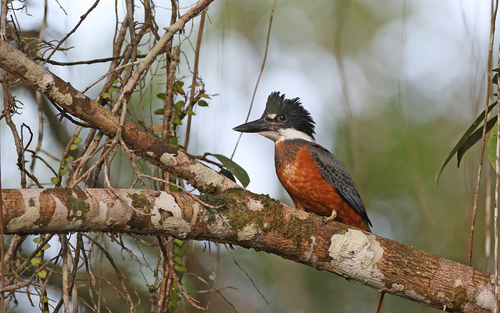
Russet-crowned Motmot

Russet-crowned Motmot

Momotus mexicanus

Silhouette: Sofía Terán Sánchez · PhyloPic

LCLeast ConcernNTVUENCR
Daily sighting probability ~30% · Possible
at Cañón del Sumidero National Park

In 3 days ~60% in a week ~90%

275 Verified sightings at Cañón del Sumidero National Park From 2019 to 2026
275 In 1 park
April Best month
☀️ Diurnal When it's spotted

About the Russet-crowned Motmot

The russet-crowned motmot (Momotus mexicanus) is a species of motmot native to north-western Mexico and central Guatemala. It is a year-round resident of the tropical and subtropical dry broadleaf forests and scrubland. The russet-crowned motmot is the most understudied species of motmot in the family Momotidae.

"Russet" refers to the reddish-brown colour of the bird's head and originates from the Latin russus meaning red. Motmots are a part of the order Coraciiformes which also includes bee-eaters, rollers, todies, and kingfishers. The russet-crowned motmot is one of seven species in the genus Momotus of the family Momotidae.

Russet-crowned motmots are very sedentary because of their strong site fidelity; 60% return to the same nesting areas as the previous year because of the low amount of suitable nesting sites. As a result, gene flow between different populations is limited which can lead to speciation. Reyes et al. found that genetic variation between three populations in Mexico was very high (12.9%) considering that the populations were relatively close.

There are four recognized subspecies of russet-crowned motmots: M.m. mexicanus M.m. vanrossemi M.m. saturates... Wikipedia →

Sounds

Song0:29

Mexico · 2022

© Manuel Grosselet · XC731176 · CC BY-NC-SA 4.0

Duet0:34

Mexico · 2021

© Aziza Cooper · XC642357 · CC BY-NC-SA 4.0

Call1:26

Mexico · 2020

© Victor Reyes · XC574007 · CC BY-NC-SA 4.0

Global Distribution

Parks Where Found

# Park Country Daily sighting probability
1 Cañón del Sumidero National Park 🇲🇽 Mexico
~30%

More parks will be added in future updates.

Cities Where Found

# City Country Daily sighting probability
1 Guadalajara 🇲🇽 México
~20%
2 Puebla 🇲🇽 México
<5%

Zoos & Centres Where Found

# Zoo / Centre Country
1 Xcaret 🇲🇽 Mexico In captivity
2 Bird Paradise 🇸🇬 Singapore In captivity
3 Rainforest Wild Asia 🇸🇬 Singapore In captivity

Before you go

What are the chances of seeing a Russet-crowned Motmot in Cañón del Sumidero National Park?

Possible

About 30% of wildlife watchers report a Russet-crowned Motmot sighting in Cañón del Sumidero National Park on a given day, based on 275 verified sightings from GBIF citizen-science data from 2019 to 2026. It is the 32nd most-seen of the 243 birds we can rate there. Over three days the chance rises to about 60%, and over a week to about 90%, if each day is a fresh chance.

When is the best time to see a Russet-crowned Motmot in Cañón del Sumidero National Park?

April

In that month about 60% of wildlife watchers report a Russet-crowned Motmot in Cañón del Sumidero National Park on a given day, against about 10% in November, the lowest month. That is one of Cañón del Sumidero National Park's driest months, with about 20 mm of rain against 260 mm in June.

What time of day is best to see a Russet-crowned Motmot?

Between 7 and 10 am

Across all the parks we cover, that three-hour window holds the most Russet-crowned Motmot sightings with a recorded time, and about 9 in 10 of them come between 6 am and 6 pm: it is a daytime animal.

Where else can you see a Russet-crowned Motmot?

Only Cañón del Sumidero National Park, in our data

Cañón del Sumidero National Park is the only park on Wallace's Line with enough records to rate Russet-crowned Motmot sightings: about 30% of wildlife watchers there report one on a given day.

Where does the Russet-crowned Motmot sighting chance come from?

GBIF citizen-science records

It is estimated from how often the Russet-crowned Motmot is recorded against all the birds logged in Cañón del Sumidero National Park (275 verified sightings from 2019 to 2026), calibrated against known sighting rates. Figures are rounded to the nearest 10% because citizen-science data supports honest approximations, not decimals, and months with records from fewer than five people show "—". How it works.

← Back to Cañón del Sumidero National Park