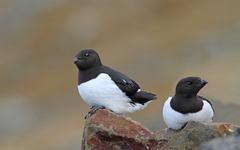
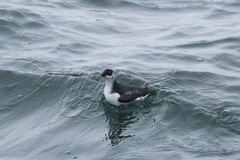
Dovekie

Dovekie

Alle alle

Silhouette: Sheatherius · PhyloPic

LCLeast ConcernNTVUENCR
Daily sighting probability <5% · Rare
at Cape Breton Highlands National Park

In 3 days <5% in a week ~10%

11 Verified sightings at Cape Breton Highlands National Park From 2019 to 2026
1,131 In all 3 parks
December Best month
☀️ Diurnal When it's spotted

About the Dovekie

The little auk (Europe) or dovekie (North America) (Alle alle) is a small auk, the only member of the genus Alle. It breeds in huge numbers on islands in the high Arctic of the North Atlantic Ocean. Lawrence Island, St. Matthew Island and the Pribilof Islands in the Bering Sea. It also formerly bred on Grímsey just north of Iceland, but is extinct there now. In winter, they disperse widely across the Arctic and North Atlantic Oceans, with the largest numbers in the Arctic close to the pack ice edge, and smaller numbers south to northern Great Britain in the eastern Atlantic, and Nova Scotia in the western Atlantic.

The little auk was formally described in 1758 by the Swedish naturalist Carl Linnaeus in the tenth edition of his Systema Naturae. He placed it with the other auks in the genus Alca and coined the binomial name Alca alle. Linnaeus specified the type locality as Ocean of Arctic... Wikipedia →

Sounds

Call0:16

Norway · 2018

© Jacob Lotz · XC428867 · CC BY-NC-SA 4.0

Flight call1:28

Norway · 2017

© Stein Ø. Nilsen · XC379429 · CC BY-NC-SA 4.0

Song0:14

Norway · 2007

© Fernand DEROUSSEN · XC135910 · CC BY-NC-ND 3.0

Global Distribution

Parks Where Found

# Park Country Daily sighting probability
1 Svalbard 🇳🇴 Norway
~50%
2 Cape Breton Highlands National Park 🇨🇦 Canada
<5%
3 Acadia National Park 🇺🇸 United States
<5%

Before you go

What are the chances of seeing a Dovekie in Cape Breton Highlands National Park?

Rare

Under 5% of wildlife watchers report a Dovekie sighting in Cape Breton Highlands National Park on a given day, based on 11 verified sightings from GBIF citizen-science data from 2019 to 2026. It is the 126th most-seen of the 145 birds we can rate there. Over three days the chance rises to under 5%, and over a week to about 10%, if each day is a fresh chance.

When is the best time to see a Dovekie in Cape Breton Highlands National Park?

December

In that month about 20% of wildlife watchers report a Dovekie in Cape Breton Highlands National Park on a given day, against under 5% in February to November, the lowest months.

What time of day is best to see a Dovekie?

Between 1 and 4 pm

Across all the parks we cover, that three-hour window holds the most Dovekie sightings with a recorded time, and about 9 in 10 of them come between 6 am and 6 pm: it is a daytime animal.

Is Cape Breton Highlands National Park the best place to see a Dovekie?

2nd of 3

Of the 3 parks where we can rate Dovekie sightings, Cape Breton Highlands National Park ranks 2nd at under 5%. The best odds are in Svalbard (Norway, about 50%).

Where does the Dovekie sighting chance come from?

GBIF citizen-science records

It is estimated from how often the Dovekie is recorded against all the birds logged in Cape Breton Highlands National Park (11 verified sightings from 2019 to 2026), calibrated against known sighting rates. Figures are rounded to the nearest 10% because citizen-science data supports honest approximations, not decimals, and months with records from fewer than five people show "—". How it works.

← Back to Cape Breton Highlands National Park