Semipalmated Plover

Semipalmated Plover

Charadrius semipalmatus

Silhouette: Andy Wilson · PhyloPic

LCLeast ConcernNTVUENCR
Daily sighting probability ~10% · With luck
at Cape Breton Highlands National Park

In 3 days ~20% in a week ~30%

66 Verified sightings at Cape Breton Highlands National Park From 2019 to 2026
13,120 In all 52 parks
September Best month
☀️ Diurnal When it's spotted

About the Semipalmated Plover

The semipalmated plover (Charadrius semipalmatus) is a small plover. Charadrius is a Late Latin word for a yellowish bird mentioned in the fourth-century Vulgate. It derives from Ancient Greek kharadrios a bird found in ravines and river valleys (kharadra, "ravine"). The specific semipalmatus is Latin and comes from semi, "half" and palma, "palm". Like the English name, this refers to its only partially webbed feet.

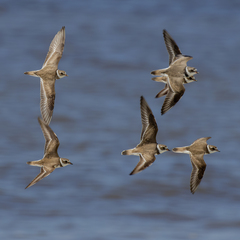
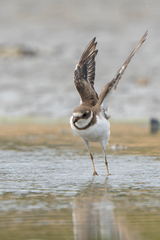
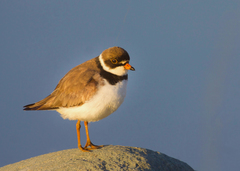
This species weighs a mean 47.4 g (1.7 oz.) for males and 46.1 g (1.6 oz.) for females, with body masses ranging from 37.6-54.7 g (1.3-1.9 oz.). and measures 17–19 cm (6.7–7.5 in) in length with a 12–13 cm (4.7–5.1 in) mean wing length. Adults have a grey-brown back and wings, a white belly, and a white breast with one black neckband. They have a brown cap, a white forehead, a black mask around the eyes and a short orange and black bill.

Their breeding habitat is open ground on beaches or flats across northern Canada and Alaska. They nest on the ground in an open area with little or no plant growth. They are migratory and winter in coastal areas of the southern United States, the Caribbean and much of South America. They are extremely rare... Wikipedia →

Sounds

Call1:10

United States · 2025

© Paul Driver · XC1032138 · CC BY-NC-SA 4.0

Song0:09

United States · 2016

© Peter Boesman · XC323096 · CC BY-NC-ND 4.0

Flight display0:48

United States · 2015

© Frank Lambert · XC277113 · CC BY-NC-ND 4.0

Global Distribution

Parks Where Found

# Park Country Daily sighting probability
1 Isla del Coco National Park 🇨🇷 Costa Rica
~70%
2 Ría Lagartos Biosphere Reserve 🇲🇽 Mexico
~40%
3 Pacific Rim National Park Reserve 🇨🇦 Canada
~30%
4 Galápagos Islands 🇪🇨 Ecuador
~30%
5 Bahía de Loreto National Park 🇲🇽 Mexico
~20%
6 El Vizcaíno Biosphere Reserve 🇲🇽 Mexico
~20%
7 Ostional Wildlife Refuge 🇨🇷 Costa Rica
~20%
8 Utría National Natural Park 🇨🇴 Colombia
~20%
9 Coiba National Park 🇵🇦 Panama
~20%
10 Carara National Park 🇨🇷 Costa Rica
~20%
11 Las Baulas Marine National Park 🇨🇷 Costa Rica
~20%
12 Caroni Swamp 🇹🇹 Trinidad and Tobago
~20%
13 Gandoca-Manzanillo Wildlife Refuge 🇨🇷 Costa Rica
~10%
14 Cabo Blanco Absolute Nature Reserve 🇨🇷 Costa Rica
~10%
15 Katmai National Park 🇺🇸 United States
~10%
16 Bastimentos Island National Marine Park 🇵🇦 Panama
~10%
17 Arrecifes de Cozumel National Park 🇲🇽 Mexico
~10%
18 Kluane National Park 🇨🇦 Canada
~10%
19 Celestún Biosphere Reserve 🇲🇽 Mexico
~10%
20 Cahuita National Park 🇨🇷 Costa Rica
~10%
21 Gros Morne National Park 🇨🇦 Canada
~10%
22 Tortuguero National Park 🇨🇷 Costa Rica
~10%
23 Merritt Island National Wildlife Refuge 🇺🇸 United States
~10%
24 Corcovado National Park 🇨🇷 Costa Rica
~10%
25 Ciénaga de Zapata 🇨🇺 Cuba
~10%
26 Padre Island National Seashore 🇺🇸 United States
~10%
27 Point Pelee National Park 🇨🇦 Canada
~10%
28 Cape Breton Highlands National Park 🇨🇦 Canada
~10%
29 Cabo Pulmo National Park 🇲🇽 Mexico
~10%
30 Channel Islands National Park 🇺🇸 United States
~10%
31 Everglades National Park 🇺🇸 United States
~10%
32 La Amistad International Park (Panama) 🇵🇦 Panama
<5%
33 Acadia National Park 🇺🇸 United States
<5%
34 Wrangell-St. Elias National Park 🇺🇸 United States
<5%
35 Great Bear Rainforest 🇨🇦 Canada
<5%
36 Los Haitises National Park 🇩🇴 Dominican Republic
<5%
37 Palo Verde National Park 🇨🇷 Costa Rica
<5%
38 Olympic National Park 🇺🇸 United States
<5%
39 Marino Ballena National Park 🇨🇷 Costa Rica
<5%
40 Santa Rosa National Park 🇨🇷 Costa Rica
<5%
41 Big Cypress National Preserve 🇺🇸 United States
<5%
42 Redwood National Park 🇺🇸 United States
<5%
43 Sian Ka'an Biosphere Reserve 🇲🇽 Mexico
<5%
44 Denali National Park 🇺🇸 United States
<5%
45 Manuel Antonio National Park 🇨🇷 Costa Rica
<5%
46 Machalilla National Park 🇪🇨 Ecuador
<5%
47 Main Ridge Forest Reserve 🇹🇹 Trinidad and Tobago
<5%
48 Piedras Blancas National Park 🇨🇷 Costa Rica
<5%
49 Parque Natural Metropolitano 🇵🇦 Panama
<5%
50 Tayrona National Natural Park 🇨🇴 Colombia
<5%
51 Shenandoah National Park 🇺🇸 United States
<5%
52 Arenal Volcano National Park 🇨🇷 Costa Rica
<5%

Cities Where Found

# City Country Daily sighting probability
1 São Luís 🇧🇷 Brazil
~40%
2 Havana 🇨🇺 Cuba
~20%
3 Panama City 🇵🇦 Panama
~10%
4 León 🇲🇽 México
~10%
5 San Diego 🇺🇸 United States
~10%
6 Anchorage 🇺🇸 United States
~10%
7 Vitória 🇧🇷 Brazil
~10%
8 Recife 🇧🇷 Brazil
~10%
9 Fortaleza 🇧🇷 Brazil
~10%
10 Lima 🇵🇪 Peru
~10%

Zoos & Centres Where Found

# Zoo / Centre Country
1 National Zoological Park 🇺🇸 United States In captivity

Before you go

What are the chances of seeing a Semipalmated Plover in Cape Breton Highlands National Park?

With luck

About 10% of wildlife watchers report a Semipalmated Plover sighting in Cape Breton Highlands National Park on a given day, based on 66 verified sightings from GBIF citizen-science data from 2019 to 2026. It is the 78th most-seen of the 145 birds we can rate there. Over three days the chance rises to about 20%, and over a week to about 30%, if each day is a fresh chance.

When is the best time to see a Semipalmated Plover in Cape Breton Highlands National Park?

August and September

In those months about 20% of wildlife watchers report a Semipalmated Plover in Cape Breton Highlands National Park on a given day, against under 5% in October to July, the lowest months.

What time of day is best to see a Semipalmated Plover?

Between 3 and 6 pm

Across all the parks we cover, that three-hour window holds the most Semipalmated Plover sightings with a recorded time, and about 9 in 10 of them come between 6 am and 6 pm: it is a daytime animal.

Which relatives of the Semipalmated Plover live in Cape Breton Highlands National Park?

Same order: Charadriiformes

The closest relatives of the Semipalmated Plover that you can see in Cape Breton Highlands National Park (order Charadriiformes, Shorebirds and Allies) are American Herring Gull (about 70%), Great Black-backed Gull (about 50%) and Black Guillemot (about 30%), with each one's daily chance of a sighting.

Where does the Semipalmated Plover sighting chance come from?

GBIF citizen-science records

It is estimated from how often the Semipalmated Plover is recorded against all the birds logged in Cape Breton Highlands National Park (66 verified sightings from 2019 to 2026), calibrated against known sighting rates. Figures are rounded to the nearest 10% because citizen-science data supports honest approximations, not decimals, and months with records from fewer than five people show "—". How it works.

← Back to Cape Breton Highlands National Park