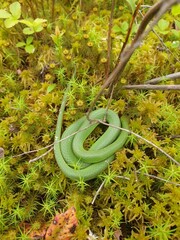

Smooth Greensnake

Smooth Greensnake

Opheodrys vernalis

Silhouette: Alex Slavenko · PhyloPic

LCLeast ConcernNTVUENCR
Daily sighting probability ~20% · Possible
at Cape Breton Highlands National Park

In 3 days ~50% in a week ~80%

10 Verified sightings at Cape Breton Highlands National Park From 2019 to 2026
85 In all 3 parks
May Best month
☀️ Diurnal When it's spotted

About the Smooth Greensnake

The smooth green snake (Opheodrys vernalis) is a species of North American nonvenomous snake in the family Colubridae. The species is also referred to as the grass snake. It is a slender, "small medium" snake that measures 36–51 cm (14–20 in) as an adult. It gets its common name from its smooth dorsal scales, as opposed to the rough green snake, which has keeled dorsal scales. The smooth green snake is found in marshes, meadows, open woods, and along stream edges, and is native to regions of Canada, the United States, and northern Mexico. A non-aggressive snake, it seldom bites and usually flees when threatened. It mates in late spring to summer, and females lay their eggs from June to September. The smooth green snake will often bob its head in order to mimic vegetation blowing in the wind.

The smooth green snake is slender. In size, it is classified as a "small medium" snake, reaching to 36–51 cm (14–20 in) in total length (including tail) as an adult. The longest smooth green snake was measured as being 66 cm (26 in) in total length. The tail makes up about 1/4 to 1/2 the total length of the snake; males have longer tails than females.

It is uniform light green... Wikipedia →

Global Distribution

Parks Where Found

# Park Country Daily sighting probability
1 Acadia National Park 🇺🇸 United States
~20%
2 Cape Breton Highlands National Park 🇨🇦 Canada
~20%
3 Shenandoah National Park 🇺🇸 United States
~10%

Cities Where Found

# City Country Daily sighting probability
1 Toronto 🇨🇦 Canada
<5%

Zoos & Centres Where Found

# Zoo / Centre Country
1 Ecomuseum Zoo 🇨🇦 Canada In captivity
2 Toronto Zoo 🇨🇦 Canada In captivity

Before you go

What are the chances of seeing a Smooth Greensnake in Cape Breton Highlands National Park?

Possible

About 20% of wildlife watchers report a Smooth Greensnake sighting in Cape Breton Highlands National Park on a given day, based on 10 verified sightings from GBIF citizen-science data from 2019 to 2026. Over three days the chance rises to about 50%, and over a week to about 80%, if each day is a fresh chance.

When is the best time to see a Smooth Greensnake in Cape Breton Highlands National Park?

May and September

In those months about 30% of wildlife watchers report a Smooth Greensnake in Cape Breton Highlands National Park on a given day, against under 5% in March–April and October–December, the lowest months.

What time of day is best to see a Smooth Greensnake?

Between noon and 3 pm

Across all the parks we cover, that three-hour window holds the most Smooth Greensnake sightings with a recorded time, and about 9 in 10 of them come between 6 am and 6 pm: it is a daytime animal.

Is Cape Breton Highlands National Park the best place to see a Smooth Greensnake?

Among the best

Of the 3 parks where we can rate Smooth Greensnake sightings, Cape Breton Highlands National Park ranks 2nd at about 20%, level with the leaders once rounded. The best odds are in Acadia National Park (United States, about 20%).

Which relatives of the Smooth Greensnake live in Cape Breton Highlands National Park?

Same family: Colubridae

The closest relatives of the Smooth Greensnake that you can see in Cape Breton Highlands National Park (family Colubridae, Colubrid Snakes) are Common Garter Snake (about 70%), Ringneck Snake (about 20%) and Redbelly Snake (about 20%), with each one's daily chance of a sighting.

Where does the Smooth Greensnake sighting chance come from?

GBIF citizen-science records

It is estimated from how often the Smooth Greensnake is recorded against all the reptiles logged in Cape Breton Highlands National Park (10 verified sightings from 2019 to 2026), calibrated against known sighting rates. Figures are rounded to the nearest 10% because citizen-science data supports honest approximations, not decimals, and months with records from fewer than five people show "—". How it works.

← Back to Cape Breton Highlands National Park