
Common Garter Snake

Common Garter Snake

Thamnophis sirtalis

Silhouette: Alex Slavenko · PhyloPic

LCLeast ConcernNTVUENCR
Daily sighting probability ~70% · Very likely
at Cape Breton Highlands National Park

In 3 days >90%

116 Verified sightings at Cape Breton Highlands National Park From 2019 to 2026
2,656 In all 18 parks
June Best month
☀️ Diurnal When it's spotted

About the Common Garter Snake

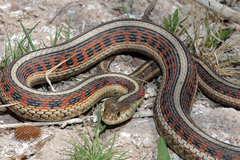
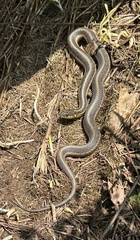
The common garter snake (Thamnophis sirtalis) is a species of snake in the subfamily Natricinae of the family Colubridae. The species is indigenous to North America and found widely across the continent. There are several recognized subspecies. Most common garter snakes have a pattern of yellow stripes on a black, brown or green background, and their average total length (including tail) is about 55 cm (22 in), with a maximum total length of about 137 cm (54 in). The average body mass is 150 g (5.3 oz). The common garter snake is the state reptile of Massachusetts.

The subspecific name fitchi is in honor of the American herpetologist Henry Sheldon Fitch. The subspecific name pickeringii is in honor of the American naturalist Charles E. Pickering. Current scientific classification recognizes 12 subspecies (ordered by date):

A trinomial authority in parentheses indicates that the subspecies was originally described in a genus other than Thamnophis. Common garter snakes are thin snakes. Few grow over about 4 ft (1.2 m) long, and most stay smaller. Most have longitudinal stripes in many different colors. Common... Wikipedia →

Sounds

Recording0:08

Canada · 2021

© Bryce · iNaturalist · CC BY-NC 4.0

Recording0:04

Canada · 2024

© troydavis · iNaturalist · CC BY-NC 4.0

Global Distribution

Parks Where Found

# Park Country Daily sighting probability
1 Wood Buffalo National Park 🇨🇦 Canada
~80%
2 Cape Breton Highlands National Park 🇨🇦 Canada
~70%
3 Isle Royale National Park 🇺🇸 United States
~70%
4 Point Pelee National Park 🇨🇦 Canada
~50%
5 Voyageurs National Park 🇺🇸 United States
~50%
6 Acadia National Park 🇺🇸 United States
~50%
7 Shenandoah National Park 🇺🇸 United States
~40%
8 Great Smoky Mountains National Park 🇺🇸 United States
~40%
9 Redwood National Park 🇺🇸 United States
~40%
10 Pacific Rim National Park Reserve 🇨🇦 Canada
~40%
11 Olympic National Park 🇺🇸 United States
~30%
12 Big Cypress National Preserve 🇺🇸 United States
~20%
13 Everglades National Park 🇺🇸 United States
~20%
14 Great Bear Rainforest 🇨🇦 Canada
~20%
15 Congaree National Park 🇺🇸 United States
~10%
16 Merritt Island National Wildlife Refuge 🇺🇸 United States
~10%
17 Glacier National Park 🇺🇸 United States
~10%
18 Grand Teton National Park 🇺🇸 United States
~10%

Cities Where Found

# City Country Daily sighting probability
1 Philadelphia 🇺🇸 United States
~30%
2 Baltimore 🇺🇸 United States
~30%
3 Detroit 🇺🇸 United States
~20%
4 Boston 🇺🇸 United States
~20%
5 Montreal 🇨🇦 Canada
~20%
6 Toronto 🇨🇦 Canada
~20%
7 Washington 🇺🇸 United States
~20%
8 Vancouver 🇨🇦 Canada
~20%
9 Minneapolis [Saint Paul] 🇺🇸 United States
~20%
10 New York City 🇺🇸 United States
~10%

Zoos & Centres Where Found

# Zoo / Centre Country
1 Barcelona Zoo 🇪🇸 Spain In captivity
2 North Carolina Zoo 🇺🇸 United States In captivity
3 Ecomuseum Zoo 🇨🇦 Canada In captivity
4 Toledo Zoo 🇺🇸 United States In captivity
5 Wildlife World Zoo 🇺🇸 United States In captivity
6 Saint Louis Zoo 🇺🇸 United States In captivity
7 Dickerson Park Zoo 🇺🇸 United States In captivity
8 Philadelphia Zoo 🇺🇸 United States In captivity
9 Riverbanks Zoo 🇺🇸 United States In captivity
10 Aquarama Barcelona 🇪🇸 Spain In captivity
11 Western North Carolina Nature Center 🇺🇸 United States In captivity
12 Trailside Museum & Zoo 🇺🇸 United States In captivity
13 Cambridge Butterfly Conservatory 🇨🇦 Canada In captivity
14 North Carolina Aquarium at Pine Knoll Shores 🇺🇸 United States In captivity
15 Scales Nature Park 🇨🇦 Canada In captivity
16 FarmHouse Fresh Animal Sanctuary 🇺🇸 United States In captivity
17 Seattle Marine Aquarium 🇺🇸 United States In captivity

Before you go

What are the chances of seeing a Common Garter Snake in Cape Breton Highlands National Park?

Very likely

About 70% of wildlife watchers report a Common Garter Snake sighting in Cape Breton Highlands National Park on a given day, based on 116 verified sightings from GBIF citizen-science data from 2019 to 2026. Over three days the chance rises to over 90%, if each day is a fresh chance.

When is the best time to see a Common Garter Snake in Cape Breton Highlands National Park?

June

In that month about 80% of wildlife watchers report a Common Garter Snake in Cape Breton Highlands National Park on a given day, against about 10% in March and November–December, the lowest months.

What time of day is best to see a Common Garter Snake?

Between 2 and 5 pm

Across all the parks we cover, that three-hour window holds the most Common Garter Snake sightings with a recorded time, and about 9 in 10 of them come between 6 am and 6 pm: it is a daytime animal.

Is Cape Breton Highlands National Park the best place to see a Common Garter Snake?

2nd of 18

Of the 18 parks where we can rate Common Garter Snake sightings, Cape Breton Highlands National Park ranks 2nd at about 70%. The best odds are in Wood Buffalo National Park (Canada, about 80%). All parks ranked.

Which relatives of the Common Garter Snake live in Cape Breton Highlands National Park?

Same family: Colubridae

The closest relatives of the Common Garter Snake that you can see in Cape Breton Highlands National Park (family Colubridae, Colubrid Snakes) are Smooth Greensnake (about 20%), Ringneck Snake (about 20%) and Redbelly Snake (about 20%), with each one's daily chance of a sighting.

Where does the Common Garter Snake sighting chance come from?

GBIF citizen-science records

It is estimated from how often the Common Garter Snake is recorded against all the reptiles logged in Cape Breton Highlands National Park (116 verified sightings from 2019 to 2026), calibrated against known sighting rates. Figures are rounded to the nearest 10% because citizen-science data supports honest approximations, not decimals, and months with records from fewer than five people show "—". How it works.

← Back to Cape Breton Highlands National Park