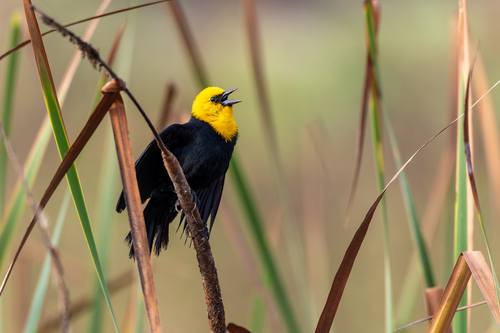
Masked Yellowthroat

Masked Yellowthroat

Geothlypis aequinoctialis

Silhouette: Andy Wilson · PhyloPic

LCLeast ConcernNTVUENCR
Daily sighting probability ~10% · With luck
at Caroni Swamp

In 3 days ~30% in a week ~60%

63 Verified sightings at Caroni Swamp From 2019 to 2026
63 In 1 park
September Best month
☀️ Diurnal When it's spotted

About the Masked Yellowthroat

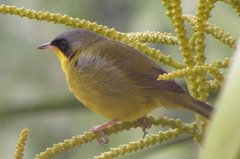
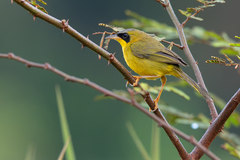
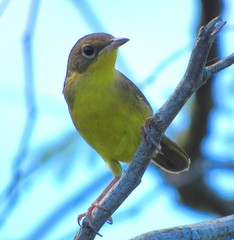
The masked yellowthroat (Geothlypis aequinoctialis) is a species of bird in the family Parulidae, the New World warblers. It is found in Brazil, Colombia, French Guiana, Guyana, Suriname, Trinidad, and Venezuela. The masked yellowthroat was formally described in 1789 with the binomial Motacilla aequinoctialis, erroneously classing it as a wagtail but calling it the "equatorial warbler".

The masked yellowthroat's taxonomic history since its description is complicated and not yet resolved. Well into the twenty-first century taxonomists included up to five subspecies in it. In 2015 the IOC reclassified two of them as the black-lored yellowthroat (Geothlypis auricularis), a third as the southern yellowthroat (G. velata), and the fourth as the Chiriqui yellowthroat (G. chiriquensis), leaving the masked yellowthroat as monotypic. As of early 2026 it retains these four species.

In 2017 BirdLife International's Handbook of the Birds of the World (HBW) separated the black-lored and Chiriqui yellowthroats as species but retained velata as a subspecies of the masked yellowthroat. As of late 2025 it retains this three-species treatment.

In 2018 the American Ornithological... Wikipedia →

Sounds

Song0:14

Uruguay · 2010

© Pedro Rinaldi · XC1085498 · CC BY-NC-SA 4.0

Call0:20

Argentina · 2022

© Guillermo Treboux · XC777627 · CC BY-NC-SA 4.0

Song0:12

Brazil · 2024

© JAYRSON ARAUJO DE OLIVEIRA · XC939488 · CC BY-NC-SA 4.0

Global Distribution

Parks Where Found

# Park Country Daily sighting probability
1 Caroni Swamp 🇹🇹 Trinidad and Tobago
~10%

More parks will be added in future updates.

Cities Where Found

# City Country Daily sighting probability
1 Caracas 🇻🇪 Venezuela
<5%

Before you go

What are the chances of seeing a Masked Yellowthroat in Caroni Swamp?

With luck

About 10% of wildlife watchers report a Masked Yellowthroat sighting in Caroni Swamp on a given day, based on 63 verified sightings from GBIF citizen-science data from 2019 to 2026. It is the 82nd most-seen of the 169 birds we can rate there. Over three days the chance rises to about 30%, and over a week to about 60%, if each day is a fresh chance.

When is the best time to see a Masked Yellowthroat in Caroni Swamp?

July and September

In those months about 30% of wildlife watchers report a Masked Yellowthroat in Caroni Swamp on a given day, against under 5% in April and December, the lowest months. Those are among Caroni Swamp's wettest months, with about 110 mm of rain a month against 25 mm in February.

What time of day is best to see a Masked Yellowthroat?

Between 7 and 10 am

Across all the parks we cover, that three-hour window holds the most Masked Yellowthroat sightings with a recorded time, and about 9 in 10 of them come between 6 am and 6 pm: it is a daytime animal.

Where else can you see a Masked Yellowthroat?

Only Caroni Swamp, in our data

Caroni Swamp is the only park on Wallace's Line with enough records to rate Masked Yellowthroat sightings: about 10% of wildlife watchers there report one on a given day.

Which relatives of the Masked Yellowthroat live in Caroni Swamp?

Same family: Parulidae

The closest relatives of the Masked Yellowthroat that you can see in Caroni Swamp (family Parulidae, New World Warblers) are Northern Waterthrush (about 40%), Yellow Warbler (about 30%) and American Redstart (about 20%), with each one's daily chance of a sighting.

Where does the Masked Yellowthroat sighting chance come from?

GBIF citizen-science records

It is estimated from how often the Masked Yellowthroat is recorded against all the birds logged in Caroni Swamp (63 verified sightings from 2019 to 2026), calibrated against known sighting rates. Figures are rounded to the nearest 10% because citizen-science data supports honest approximations, not decimals, and months with records from fewer than five people show "—". How it works.

← Back to Caroni Swamp