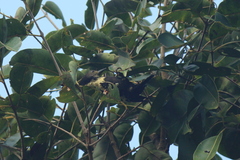
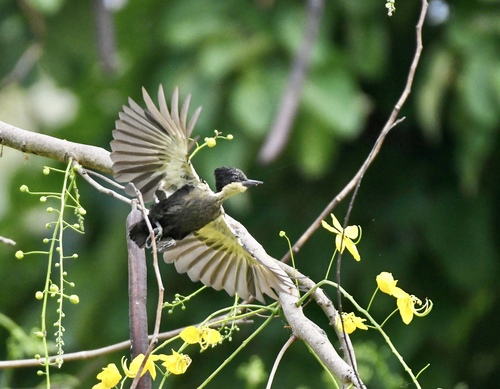
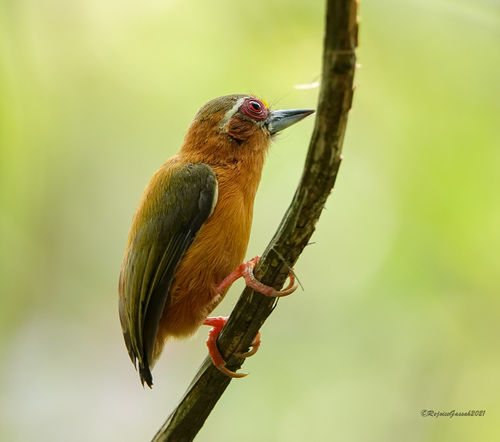
Black-and-buff Woodpecker

Black-and-buff Woodpecker

Meiglyptes jugularis

Silhouette: Pepe Reigada · PhyloPic

LCLeast ConcernNTVUENCR
Daily sighting probability ~20% · Possible
at Cat Tien National Park

In 3 days ~50% in a week ~80%

267 Verified sightings at Cat Tien National Park From 2019 to 2026
424 In all 3 parks
April Best month
🌅 Crepuscular When it's spotted

About the Black-and-buff Woodpecker

The black-and-buff woodpecker (Meiglyptes jugularis) is a species of bird in the family Picidae. It is native to Southeast Asia. Meiglyptes jugularis was described by the zoologist Edward Blyth in 1845. In his Catalogue of Mammals and Birds of Burma, he notes that the species was previously described by Sundevall (likely Carl Jakob Sundevall) in 1842 as a species dubiae. Sundevall includes a description of M. jugularis in his 1866 work Conspectum avium picinarum.

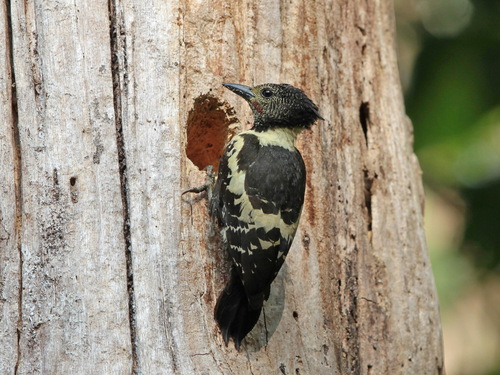
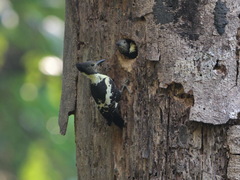
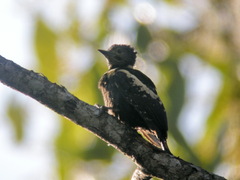
Meiglyptes jugularis has a distinct patchy black-and-white pattern and a triangular crest. The base of the bill has a subtle reddish tinge in males; the two sexes are otherwise similar in appearance. Meiglyptes jugularis has been observed in Cambodia, Laos, Myanmar, Thailand, and Vietnam. It inhabits lowland forests and prefers open patches and forest edges. It is presumed to be threatened by deforestation in its home range.

Meiglyptes jugularis forages alone or in pairs. It gravitates towards slender branches and leaf clusters when foraging. Wikipedia →

Sounds

Call0:10

Vietnam · 2026

© Ding Li Yong · XC1106830 · CC BY-NC-ND 4.0

Song0:41

Vietnam

© Craig Robson · XC19202 · CC BY-NC-ND 2.5

Call0:26

Thailand · 2014

© Jelle Scharringa · XC620806 · CC BY-NC-SA 4.0

Global Distribution

Parks Where Found

# Park Country Daily sighting probability
1 Cat Tien National Park 🇻🇳 Vietnam
~20%
2 Khao Yai National Park 🇹🇭 Thailand
~10%
3 Kaeng Krachan National Park 🇹🇭 Thailand
<5%

Before you go

What are the chances of seeing a Black-and-buff Woodpecker in Cat Tien National Park?

Possible

About 20% of wildlife watchers report a Black-and-buff Woodpecker sighting in Cat Tien National Park on a given day, based on 267 verified sightings from GBIF citizen-science data from 2019 to 2026. It is the 92nd most-seen of the 244 birds we can rate there. Over three days the chance rises to about 50%, and over a week to about 80%, if each day is a fresh chance.

When is the best time to see a Black-and-buff Woodpecker in Cat Tien National Park?

April and May

In those months about 30% of wildlife watchers report a Black-and-buff Woodpecker in Cat Tien National Park on a given day, against about 10% in June to January, the lowest months.

What time of day is best to see a Black-and-buff Woodpecker?

Between 3 and 6 am

Across all the parks we cover, that three-hour window holds the most Black-and-buff Woodpecker sightings with a recorded time, and about 6 in 10 of them come between 6 pm and 6 am: it is most active around dawn and dusk.

Is Cat Tien National Park the best place to see a Black-and-buff Woodpecker?

Yes

Of the 3 parks where we can rate Black-and-buff Woodpecker sightings, Cat Tien National Park has the highest daily chance: about 20%. Next come Khao Yai National Park (Thailand, about 10%) and Kaeng Krachan National Park (Thailand, under 5%).

Which relatives of the Black-and-buff Woodpecker live in Cat Tien National Park?

Same family: Picidae

The closest relatives of the Black-and-buff Woodpecker that you can see in Cat Tien National Park (family Picidae, Woodpeckers) are Common Flameback (about 40%), Laced Woodpecker (about 40%) and Lesser Yellownape (about 20%), with each one's daily chance of a sighting.

Where does the Black-and-buff Woodpecker sighting chance come from?

GBIF citizen-science records

It is estimated from how often the Black-and-buff Woodpecker is recorded against all the birds logged in Cat Tien National Park (267 verified sightings from 2019 to 2026), calibrated against known sighting rates. Figures are rounded to the nearest 10% because citizen-science data supports honest approximations, not decimals, and months with records from fewer than five people show "—". How it works.

← Back to Cat Tien National Park