Black-shanked Douc Langur

Black-shanked Douc Langur

Pygathrix nigripes

Silhouette: Vu Hung (photograph) · PhyloPic

LCNTVUENCRCritically Endangered
Daily sighting probability ~60% · Likely
at Cat Tien National Park

In 3 days ~90% in a week >90%

231 Verified sightings at Cat Tien National Park From 2019 to 2026
231 In 1 park
March Best month
🌅 Crepuscular When it's spotted

About the Black-shanked Douc Langur

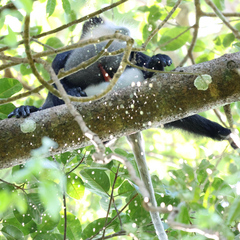
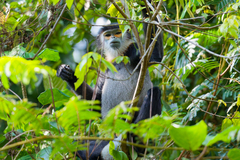
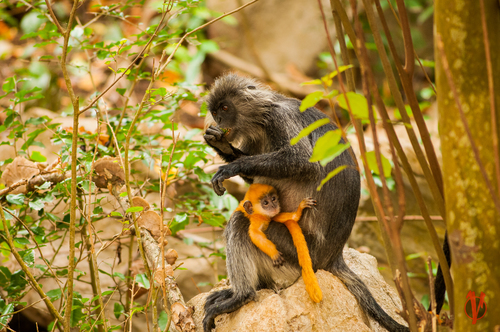
The black-shanked douc (Pygathrix nigripes) is an endangered species of douc found mostly in the forests of Eastern Cambodia, with some smaller populations in Southern Vietnam. The region they are mostly found in is called the Annamite Range, a mountainous area that passes through Cambodia and Vietnam. Its habitat is mostly characterized by evergreen forest in the mountains, in the middle to upper canopy. They move around quadrupedally and by brachiation up in the trees. This species is unique with its coloration among the doucs as it has a bluish face with yellow rings around its eyes a blue scrotum and a pink penis. Like other doucs, this species has a tail as long as its body and head length. Black-shanked douc have been observed in groups ranging from 3 to 30 individuals, depending on their habitat. Group tend to have a fission-fusion dynamic that changes with food availability. Their diet varies from dry to wet season. Regardless of the season, their diet consists mostly of leaves, but they have also been found to consume considerable amounts of fruits and flowers during wet season. The species changed conservation status in 2015 from endangered to critically endangered in the IUCN Red List of Endangered Species. This reassessment is due to an increase of the rate of population decline. No global population estimate exists. The majority of the population can be found in Cambodia, with smaller populations in Vietnam. In fact, the Wildlife Conservation Society reports almost 25,000 individuals in Cambodia's Keo Seima Wildlife Sanctuary, a population that has remained stable over the last decade. The largest populations estimated to be in Vietnam is around 500-600 individuals. The biggest challenges that the black-shanked douc faces in terms of conservation are habitat loss and illegal poaching. Conservation efforts are being made to control illegal poaching and trade in Vietnam by putting laws against hunting and trading threatened species. Wikipedia →

Sounds

Recording0:12

Cambodia · 2025

© Alec Lindsay · iNaturalist · CC BY-NC 4.0

Global Distribution

Parks Where Found

# Park Country Daily sighting probability
1 Cat Tien National Park 🇻🇳 Vietnam
~60%

More parks will be added in future updates.

Zoos & Centres Where Found

# Zoo / Centre Country
1 Saigon Zoo and Botanical Gardens 🇻🇳 Vietnam In captivity
2 King's Garden 🇻🇳 Vietnam In captivity

Before you go

What are the chances of seeing a Black-shanked Douc Langur in Cat Tien National Park?

Likely

About 60% of wildlife watchers report a Black-shanked Douc Langur sighting in Cat Tien National Park on a given day, based on 231 verified sightings from GBIF citizen-science data from 2019 to 2026. It is the most-seen of the 28 mammals we can rate there. Over three days the chance rises to about 90%, and over a week to over 90%, if each day is a fresh chance.

When is the best time to see a Black-shanked Douc Langur in Cat Tien National Park?

January and March

In those months about 80% of wildlife watchers report a Black-shanked Douc Langur in Cat Tien National Park on a given day, against about 30% in June, the lowest month. Those are among Cat Tien National Park's driest months, with about 30 mm of rain a month against 490 mm in July.

What time of day is best to see a Black-shanked Douc Langur?

Between 10 am and 1 pm

Across all the parks we cover, that three-hour window holds the most Black-shanked Douc Langur sightings with a recorded time, and about half of them come between 6 am and 6 pm: it is most active around dawn and dusk.

Where else can you see a Black-shanked Douc Langur?

Only Cat Tien National Park, in our data

Cat Tien National Park is the only park on Wallace's Line with enough records to rate Black-shanked Douc Langur sightings: about 60% of wildlife watchers there report one on a given day.

Which relatives of the Black-shanked Douc Langur live in Cat Tien National Park?

Same family: Cercopithecidae

The closest relatives of the Black-shanked Douc Langur that you can see in Cat Tien National Park (family Cercopithecidae, Old World Monkeys) are Crab-eating Macaque (about 30%), Northern Pig-tailed Macaque (about 30%) and Annamese Langur (about 30%), with each one's daily chance of a sighting.

Where does the Black-shanked Douc Langur sighting chance come from?

GBIF citizen-science records

It is estimated from how often the Black-shanked Douc Langur is recorded against all the mammals logged in Cat Tien National Park (231 verified sightings from 2019 to 2026), calibrated against known sighting rates. Figures are rounded to the nearest 10% because citizen-science data supports honest approximations, not decimals, and months with records from fewer than five people show "—". How it works.

← Back to Cat Tien National Park