Gray Whale

Gray Whale

Eschrichtius robustus

Silhouette: Chris huh · PhyloPic

LCLeast ConcernNTVUENCR
Daily sighting probability ~20% · Possible
at Channel Islands National Park

In 3 days ~40% in a week ~70%

38 Verified sightings at Channel Islands National Park From 2019 to 2026
393 In all 7 parks
January Best month
☀️ Diurnal When it's spotted

About the Gray Whale

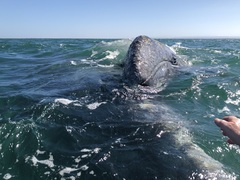
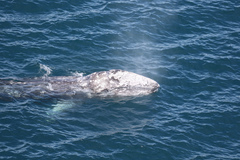
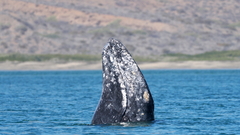
The gray whale (Eschrichtius robustus), also known as the grey whale, is a baleen whale that migrates between feeding and breeding grounds yearly. It reaches a length of 14.9–15.2 m (49–50 ft), a weight of up to 41 to 45 tonnes (45 to 50 short tons; 40 to 44 long tons) and lives between 55 and 70 years, although one female was estimated to be 75–80 years of age. One of the longest-living gray whales currently is a female, first sighted in 1977, and estimated to be 53–55 years old as of 2024. The common name of the whale comes from the gray patches and white mottling on its dark skin. Gray whales were once called "devil fish" because of their fighting behavior when hunted, with mothers accompanied by their calves fighting viciously to protect their young if they are attacked. The gray whale is the sole living species in the genus Eschrichtius. It is the sole living genus in the family Eschrichtiidae; however, some recent studies classify it as a member of the family Balaenopteridae. This mammal is descended from filter-feeding whales that appeared during the Neogene.

The gray whale is distributed in a Northeast Pacific (North American), and an endangered Northwest Pacific (Asian), population. North Atlantic populations were extirpated (perhaps by whaling) on the European coast in the 12th to 14th centuries, and on the American and African Atlantic coasts around the late 17th to early 18th centuries. However, in the 2010s and 2020s there have been rare sightings of gray whales in the North Atlantic, Mediterranean, and even off South Atlantic coasts. Wikipedia →

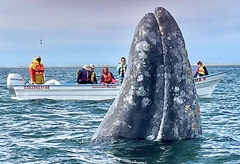
Global Distribution

Parks Where Found

# Park Country Daily sighting probability
1 El Vizcaíno Biosphere Reserve 🇲🇽 Mexico
~70%
2 Cabo Pulmo National Park 🇲🇽 Mexico
~20%
3 Pacific Rim National Park Reserve 🇨🇦 Canada
~20%
4 Channel Islands National Park 🇺🇸 United States
~20%
5 Olympic National Park 🇺🇸 United States
~10%
6 Redwood National Park 🇺🇸 United States
~10%
7 Great Bear Rainforest 🇨🇦 Canada
~10%

Cities Where Found

# City Country Daily sighting probability
1 Vancouver 🇨🇦 Canada
<5%
2 San Francisco 🇺🇸 United States
<5%
3 San Diego 🇺🇸 United States
<5%
4 Los Angeles 🇺🇸 United States
<5%

Zoos & Centres Where Found

# Zoo / Centre Country
1 The Marine Mammal Center 🇺🇸 United States In captivity

Before you go

What are the chances of seeing a Gray Whale in Channel Islands National Park?

Possible

About 20% of wildlife watchers report a Gray Whale sighting in Channel Islands National Park on a given day, based on 38 verified sightings from GBIF citizen-science data from 2019 to 2026. It is the 10th most-seen of the 22 mammals we can rate there. Over three days the chance rises to about 40%, and over a week to about 70%, if each day is a fresh chance.

When is the best time to see a Gray Whale in Channel Islands National Park?

January and February

In those months about 40% of wildlife watchers report a Gray Whale in Channel Islands National Park on a given day, against under 5% in July to December, the lowest months. Those are among Channel Islands National Park's wettest months, with about 55 mm of rain a month against almost none in July.

What time of day is best to see a Gray Whale?

Between 10 am and 1 pm

Across all the parks we cover, that three-hour window holds the most Gray Whale sightings with a recorded time, and about 8 in 10 of them come between 6 am and 6 pm: it is a daytime animal.

Which relatives of the Gray Whale live in Channel Islands National Park?

Same order: Cetacea

The closest relatives of the Gray Whale that you can see in Channel Islands National Park (order Cetacea) are Common Dolphin (about 30%), Bottlenose Dolphin (about 20%) and Humpback Whale (about 20%), with each one's daily chance of a sighting.

Where does the Gray Whale sighting chance come from?

GBIF citizen-science records

It is estimated from how often the Gray Whale is recorded against all the mammals logged in Channel Islands National Park (38 verified sightings from 2019 to 2026), calibrated against known sighting rates. Figures are rounded to the nearest 10% because citizen-science data supports honest approximations, not decimals, and months with records from fewer than five people show "—". How it works.

← Back to Channel Islands National Park