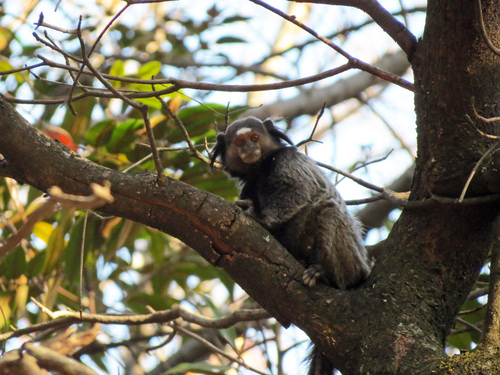
Blond Titi Monkey

Blond Titi Monkey

Callicebus barbarabrownae

Silhouette: T. Michael Keesey · PhyloPic

LCNTVUENCRCritically Endangered Endemic
Daily sighting probability ~20% · Possible
at Chapada Diamantina National Park

In 3 days ~50% in a week ~80%

8 Verified sightings at Chapada Diamantina National Park From 2019 to 2026
8 In 1 park
May Best month
☀️ Diurnal When it's spotted

About the Blond Titi Monkey

Barbara Brown's titi monkey (Callicebus barbarabrownae), also popularly known as the blond titi monkey or northern Bahian blond titi, is a species of titi, a type of New World monkey. This critically endangered species is endemic to the Caatinga in northeastern Brazil, and it is estimated that less than 250 mature individuals remain. It is named after the zoologist Barbara Elaine Russell Brown.

The blonde titi monkey is listed as Critically Endangered due to small population size. The blond titi monkey is endemic to the Atlantic forests of eastern Brazil, where it is found in the coastal highlands of Bahia and Sergipe States. Most of its population is found between the Paraguaçu River (north) and Salvador (south), and west towards Mirorós. The estimated population is 260 individuals and is decreasing.

C. barbarabrownae has been listed among the World's 25 Most Endangered Primates in 2012. The blond titi prefers habitats in caatinga, a dry scrubland, specifically those that are dense and feature trees. They display arboreal tendencies, rarely descending to the ground. They are small in size and are agile primates, good climbers who utilize all... Wikipedia →


Global Distribution

Parks Where Found

# Park Country Daily sighting probability
1 Chapada Diamantina National Park 🇧🇷 Brazil
~20%

More parks will be added in future updates.

Before you go

What are the chances of seeing a Blond Titi Monkey in Chapada Diamantina National Park?

Possible

About 20% of wildlife watchers report a Blond Titi Monkey sighting in Chapada Diamantina National Park on a given day, based on 8 verified sightings from GBIF citizen-science data from 2019 to 2026. It is the 4th most-seen of the 5 mammals we can rate there. Over three days the chance rises to about 50%, and over a week to about 80%, if each day is a fresh chance.

When is the best time to see a Blond Titi Monkey in Chapada Diamantina National Park?

May, July and November

In those months about 40% of wildlife watchers report a Blond Titi Monkey in Chapada Diamantina National Park on a given day, against under 5% in March–April, June, August–October and December, the lowest months.

What time of day is best to see a Blond Titi Monkey?

Between 9 am and noon

Across all the parks we cover, that three-hour window holds the most Blond Titi Monkey sightings with a recorded time, and about 9 in 10 of them come between 6 am and 6 pm: it is a daytime animal.

Where else can you see a Blond Titi Monkey?

Only Chapada Diamantina National Park, in our data

Chapada Diamantina National Park is the only park on Wallace's Line with enough records to rate Blond Titi Monkey sightings: about 20% of wildlife watchers there report one on a given day.

Where does the Blond Titi Monkey sighting chance come from?

GBIF citizen-science records

It is estimated from how often the Blond Titi Monkey is recorded against all the mammals logged in Chapada Diamantina National Park (8 verified sightings from 2019 to 2026), calibrated against known sighting rates. Figures are rounded to the nearest 10% because citizen-science data supports honest approximations, not decimals, and months with records from fewer than five people show "—". How it works.

← Back to Chapada Diamantina National Park