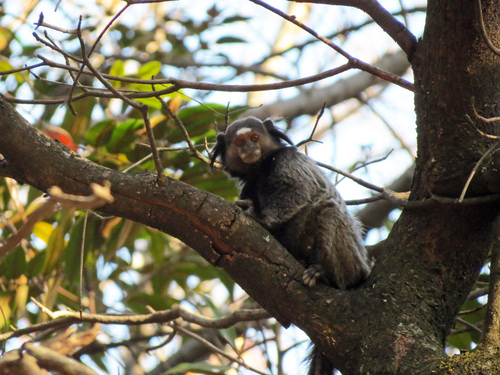
Rock Cavy

Rock Cavy

Kerodon rupestris

Silhouette: Zimices · PhyloPic

LCLeast ConcernNTVUENCR Endemic
Daily sighting probability ~30% · Possible
at Chapada Diamantina National Park

In 3 days ~70% in a week ~90%

12 Verified sightings at Chapada Diamantina National Park From 2019 to 2026
12 In 1 park
July Best month
☀️ Diurnal When it's spotted

About the Rock Cavy

The rock cavy or mocó (Kerodon rupestris) is a species of cavy that is endemic to eastern Brazil. It has also been introduced to the Atlantic island of Fernando de Noronha. The rock cavy is called mocó in Brazilian Portuguese, and koriko pexerumen in the Xukuru language of Pernambuco, Brazil.

The rock cavy is a fairly large rodent weighing up to 1 kg (2.2 lb). Like other cavy species, their tails are vestigial or absent. Their backs are grey-brown and their bellies tan to light brown. In appearance and habit, they closely resemble the unrelated African rock hyraxes (an example of convergent evolution).

They are herbivorous, feeding on seeds and leaves of the scrubby vegetation that grows in their territories. This vegetation consists of tender leaves and certain species of creeper. Rock cavies are found in dry, rocky areas with low, scrubby vegetation, and they prefer to reside close to stony mountainsides and hills.

They are native to eastern Brazil, from eastern Piauí state to Minas Gerais state, and have been introduced to the island of Fernando de Noronha, off the eastern coast of Brazil. Rock cavies belong to the... Wikipedia →

Global Distribution

Parks Where Found

# Park Country Daily sighting probability
1 Chapada Diamantina National Park 🇧🇷 Brazil
~30%

More parks will be added in future updates.

Zoos & Centres Where Found

# Zoo / Centre Country
1 Bronx Zoo 🇺🇸 United States In captivity
2 Tallinn Zoo 🇪🇪 Estonia In captivity
3 Wilhelma 🇩🇪 Germany In captivity
4 Cologne Zoological Garden 🇩🇪 Germany In captivity
5 Cologne Zoo Aquarium 🇩🇪 Germany In captivity

Before you go

What are the chances of seeing a Rock Cavy in Chapada Diamantina National Park?

Possible

About 30% of wildlife watchers report a Rock Cavy sighting in Chapada Diamantina National Park on a given day, based on 12 verified sightings from GBIF citizen-science data from 2019 to 2026. It is the 2nd most-seen of the 5 mammals we can rate there. Over three days the chance rises to about 70%, and over a week to about 90%, if each day is a fresh chance.

When is the best time to see a Rock Cavy in Chapada Diamantina National Park?

February, June–July, October and December

In those months about 40% of wildlife watchers report a Rock Cavy in Chapada Diamantina National Park on a given day, against under 5% in March and April, the lowest months.

What time of day is best to see a Rock Cavy?

Between 9 am and noon

Across all the parks we cover, that three-hour window holds the most Rock Cavy sightings with a recorded time, and about 9 in 10 of them come between 6 am and 6 pm: it is a daytime animal.

Where else can you see a Rock Cavy?

Only Chapada Diamantina National Park, in our data

Chapada Diamantina National Park is the only park on Wallace's Line with enough records to rate Rock Cavy sightings: about 30% of wildlife watchers there report one on a given day.

Where does the Rock Cavy sighting chance come from?

GBIF citizen-science records

It is estimated from how often the Rock Cavy is recorded against all the mammals logged in Chapada Diamantina National Park (12 verified sightings from 2019 to 2026), calibrated against known sighting rates. Figures are rounded to the nearest 10% because citizen-science data supports honest approximations, not decimals, and months with records from fewer than five people show "—". How it works.

← Back to Chapada Diamantina National Park