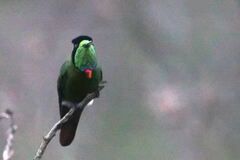
Hooded Visorbearer

Hooded Visorbearer

Augastes lumachella

Silhouette: Ferran Sayol · PhyloPic

LCNTNear ThreatenedVUENCR Endemic
Daily sighting probability ~40% · Likely
at Chapada Diamantina National Park

In 3 days ~80% in a week >90%

372 Verified sightings at Chapada Diamantina National Park From 2019 to 2026
372 In 1 park
December Best month
☀️ Diurnal When it's spotted

About the Hooded Visorbearer

The hooded visorbearer (Augastes lumachella) is a small species of hummingbird in the family Trochilidae. Endemic to the east Brazilian state of Bahia, it is found only at higher altitudes in the Chapada Diamantina region. The species is sexually dimorphic.

It resides in the campo rupestre, an arid, high-elevation area characterized by rocky outcrops, poor soils, open habitats, and harsh climatic conditions. There, it feeds primarily on nectar, though it also takes insects. Its breeding ecology remains largely undescribed, though it is known to build its nest from cactus spines. The International Union for Conservation of Nature rates it as a near-threatened species, primarily because of the relatively small size of its range. It is threatened by habitat loss, brought about primarily by unregulated mining and the conversion of the campo to pastureland and human habitation. Climate change is projected to cause a major contraction of its range – perhaps by as much as 90%.

Rene Primevere Lesson first described the hooded visorbearer for science in 1838, using a specimen collected in Bahia, Brazil. He named it Ornismya lumachella. Five years later, Lesson... Wikipedia →

Sounds

Song0:56

Brazil · 2020

© Ciro Albano · XC584122 · CC BY-NC-SA 4.0

Canto0:51

Brazil · 2018

© Caio Brito · XC556157 · CC BY-NC-SA 4.0

Call0:12

Brazil · 2011

© Hans Matheve · XC212594 · CC BY-NC-ND 4.0

Global Distribution

Parks Where Found

# Park Country Daily sighting probability
1 Chapada Diamantina National Park 🇧🇷 Brazil
~40%

More parks will be added in future updates.

Before you go

What are the chances of seeing a Hooded Visorbearer in Chapada Diamantina National Park?

Likely

About 40% of wildlife watchers report a Hooded Visorbearer sighting in Chapada Diamantina National Park on a given day, based on 372 verified sightings from GBIF citizen-science data from 2019 to 2026. It is the 16th most-seen of the 271 birds we can rate there. Over three days the chance rises to about 80%, and over a week to over 90%, if each day is a fresh chance.

When is the best time to see a Hooded Visorbearer in Chapada Diamantina National Park?

August and December

In those months about 60% of wildlife watchers report a Hooded Visorbearer in Chapada Diamantina National Park on a given day, against about 30% in June and October, the lowest months.

What time of day is best to see a Hooded Visorbearer?

Between 6 and 9 am

Across all the parks we cover, that three-hour window holds the most Hooded Visorbearer sightings with a recorded time, and about 8 in 10 of them come between 6 am and 6 pm: it is a daytime animal.

Where else can you see a Hooded Visorbearer?

Only Chapada Diamantina National Park, in our data

Chapada Diamantina National Park is the only park on Wallace's Line with enough records to rate Hooded Visorbearer sightings: about 40% of wildlife watchers there report one on a given day.

Which relatives of the Hooded Visorbearer live in Chapada Diamantina National Park?

Same family: Trochilidae

The closest relatives of the Hooded Visorbearer that you can see in Chapada Diamantina National Park (family Trochilidae, Hummingbirds) are Glittering-bellied Emerald (about 50%), White-vented Violetear (about 40%) and Planalto Hermit (about 40%), with each one's daily chance of a sighting.

Where does the Hooded Visorbearer sighting chance come from?

GBIF citizen-science records

It is estimated from how often the Hooded Visorbearer is recorded against all the birds logged in Chapada Diamantina National Park (372 verified sightings from 2019 to 2026), calibrated against known sighting rates. Figures are rounded to the nearest 10% because citizen-science data supports honest approximations, not decimals, and months with records from fewer than five people show "—". How it works.

← Back to Chapada Diamantina National Park