White-vented Violetear

White-vented Violetear

Colibri serrirostris

Silhouette: Ferran Sayol · PhyloPic

LCLeast ConcernNTVUENCR
Daily sighting probability ~40% · Likely
at Chapada Diamantina National Park

In 3 days ~80% in a week >90%

311 Verified sightings at Chapada Diamantina National Park From 2019 to 2026
979 In all 6 parks
July Best month
☀️ Diurnal When it's spotted

About the White-vented Violetear

The white-vented violetear (Colibri serrirostris) is a species of hummingbird in the subfamily Polytminae, the mangoes. It is found in Argentina, Bolivia, Brazil, and Paraguay. In April, 2024, one was also photographed at Batsu Gardens in Costa Rica.

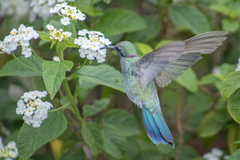
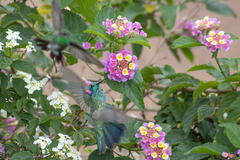
The white-vented violetear is monotypic. The white-vented violetear is 12 to 13 cm (4.7 to 5.1 in) long and weighs 5.6 to 6.8 g (0.20 to 0.24 oz). The male is mostly shiny green, of a shade lighter than that of other violetears. Towards the rump it is yellow-green with a blue shimmer. The tail is glittering green with a wide steel-blue band near the end. The undertail coverts are pure white. The area behind the eye and covering the ears is violet blue. The female is similar to the male but paler and more grayish. The maxilla of both sexes is sometimes serrated, which provides its specific epithet.

The white-vented violetear is found in a wide swath of southern Brazil, from Mato Grosso east to Goiás, Bahia and Espírito Santo and south to Santa Catarina. Its range extends west into Bolivia, central Paraguay, and northern Argentina as far south as Córdoba Province... Wikipedia →

Sounds

Song0:18

Brazil · 2026

© Robson Silva e Silva · XC1151459 · CC BY-NC-SA 4.0

Call1:00

Brazil · 2022

© Barry Edmonston · XC713424 · CC BY-NC-SA 4.0

Llamadas de contacto0:10

Argentina · 2017

© Nestor Fariña · XC373069 · CC BY-NC-SA 4.0

Global Distribution

Parks Where Found

# Park Country Daily sighting probability
1 Serra da Canastra National Park 🇧🇷 Brazil
~50%
2 Chapada Diamantina National Park 🇧🇷 Brazil
~40%
3 Emas National Park 🇧🇷 Brazil
~30%
4 Chapada dos Guimarães National Park 🇧🇷 Brazil
~20%
5 Itatiaia National Park 🇧🇷 Brazil
<5%
6 Amboró National Park 🇧🇴 Bolivia
<5%

Cities Where Found

# City Country Daily sighting probability
1 Curitiba 🇧🇷 Brazil
<5%
2 Belo Horizonte 🇧🇷 Brazil
<5%
3 São Paulo 🇧🇷 Brazil
<5%

Before you go

What are the chances of seeing a White-vented Violetear in Chapada Diamantina National Park?

Likely

About 40% of wildlife watchers report a White-vented Violetear sighting in Chapada Diamantina National Park on a given day, based on 311 verified sightings from GBIF citizen-science data from 2019 to 2026. It is the 19th most-seen of the 271 birds we can rate there. Over three days the chance rises to about 80%, and over a week to over 90%, if each day is a fresh chance.

When is the best time to see a White-vented Violetear in Chapada Diamantina National Park?

March, July, September and November

In those months about 50% of wildlife watchers report a White-vented Violetear in Chapada Diamantina National Park on a given day, against about 20% in January and June, the lowest months.

What time of day is best to see a White-vented Violetear?

Between 9 am and noon

Across all the parks we cover, that three-hour window holds the most White-vented Violetear sightings with a recorded time, and about 9 in 10 of them come between 6 am and 6 pm: it is a daytime animal.

Is Chapada Diamantina National Park the best place to see a White-vented Violetear?

2nd of 6

Of the 6 parks where we can rate White-vented Violetear sightings, Chapada Diamantina National Park ranks 2nd at about 40%. The best odds are in Serra da Canastra National Park (Brazil, about 50%). All parks ranked.

Where does the White-vented Violetear sighting chance come from?

GBIF citizen-science records

It is estimated from how often the White-vented Violetear is recorded against all the birds logged in Chapada Diamantina National Park (311 verified sightings from 2019 to 2026), calibrated against known sighting rates. Figures are rounded to the nearest 10% because citizen-science data supports honest approximations, not decimals, and months with records from fewer than five people show "—". How it works.

← Back to Chapada Diamantina National Park