
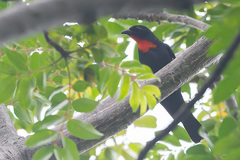
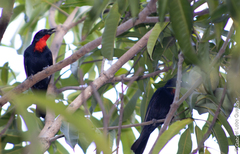

Scarlet-throated Tanager

Scarlet-throated Tanager

Compsothraupis loricata

Silhouette: Sheatherius · PhyloPic

LCLeast ConcernNTVUENCR Endemic
Daily sighting probability <5% · Rare
at Chapada Diamantina National Park

In 3 days ~10% in a week ~30%

32 Verified sightings at Chapada Diamantina National Park From 2019 to 2026
32 In 1 park
July Best month
☀️ Diurnal When it's spotted

About the Scarlet-throated Tanager

The scarlet-throated tanager (Compsothraupis loricata) is a species of bird in the family Thraupidae, the tanagers and allies. It is endemic to Brazil. The scarlet-throated tanager was formally described in 1819 by the German naturalist Hinrich Lichtenstein with the binomial Tanagra loricata. Lichtenstein based his description on the Jacapú that had been described in 1648 by Georg Marcgrave. The type locality is northeastern Brazil.

The scarlet-throated tanager is now the only member of the genus Compsothraupis that was introduced in 1915 by the American ornithologist Charles Wallace Richmond. The genus name is formed from the Ancient Greek kompsos meaning "pretty" with thraupis, an unknown small bird. In ornithology thraupis is used to signify a tanager. The specific epithet loricata is from the Latin loricatus meaning "clothed in mail" or "breast-plated". Some mid-twentieth century authors merged Compsothraupis into the genus Sericossypha, which is now occupied solely by the white-capped tanager (S. albocristata). Due to the species' nesting and flocking behavior it has also been suggested to better belong to another family, with the New World blackbirds... Wikipedia →

Sounds

Call0:36

Brazil · 2025

© JAYRSON ARAUJO DE OLIVEIRA · XC1025717 · CC BY-NC-SA 4.0

Chamado1:07

Brazil · 2015

© Caio Brito · XC427242 · CC BY-NC-SA 4.0

Call?0:21

Brazil · 2010

© Cid Espínola · XC90595 · CC BY-NC-ND 2.5

Global Distribution

Parks Where Found

# Park Country Daily sighting probability
1 Chapada Diamantina National Park 🇧🇷 Brazil
<5%

More parks will be added in future updates.

Before you go

What are the chances of seeing a Scarlet-throated Tanager in Chapada Diamantina National Park?

Rare

Under 5% of wildlife watchers report a Scarlet-throated Tanager sighting in Chapada Diamantina National Park on a given day, based on 32 verified sightings from GBIF citizen-science data from 2019 to 2026. It is the 171st most-seen of the 271 birds we can rate there. Over three days the chance rises to about 10%, and over a week to about 30%, if each day is a fresh chance.

When is the best time to see a Scarlet-throated Tanager in Chapada Diamantina National Park?

July

In that month about 20% of wildlife watchers report a Scarlet-throated Tanager in Chapada Diamantina National Park on a given day, against under 5% in June, September–October and December–April, the lowest months.

What time of day is best to see a Scarlet-throated Tanager?

Between 6 and 9 am

Across all the parks we cover, that three-hour window holds the most Scarlet-throated Tanager sightings with a recorded time, and about 9 in 10 of them come between 6 am and 6 pm: it is a daytime animal.

Where else can you see a Scarlet-throated Tanager?

Only Chapada Diamantina National Park, in our data

Chapada Diamantina National Park is the only park on Wallace's Line with enough records to rate Scarlet-throated Tanager sightings: under 5% of wildlife watchers there report one on a given day.

Which relatives of the Scarlet-throated Tanager live in Chapada Diamantina National Park?

Same family: Thraupidae

The closest relatives of the Scarlet-throated Tanager that you can see in Chapada Diamantina National Park (family Thraupidae, Tanagers and Allies) are Bananaquit (about 60%), Blue Dacnis (about 50%) and Red-cowled Cardinal (about 50%), with each one's daily chance of a sighting.

Where does the Scarlet-throated Tanager sighting chance come from?

GBIF citizen-science records

It is estimated from how often the Scarlet-throated Tanager is recorded against all the birds logged in Chapada Diamantina National Park (32 verified sightings from 2019 to 2026), calibrated against known sighting rates. Figures are rounded to the nearest 10% because citizen-science data supports honest approximations, not decimals, and months with records from fewer than five people show "—". How it works.

← Back to Chapada Diamantina National Park