
Dot-eared Coquette

Dot-eared Coquette

Lophornis gouldii

Silhouette: Ferran Sayol · PhyloPic

LCNTNear ThreatenedVUENCR
Daily sighting probability <5% · Rare
at Chapada dos Guimarães National Park

In 3 days ~10% in a week ~30%

34 Verified sightings at Chapada dos Guimarães National Park From 2019 to 2026
34 In 1 park
September Best month
☀️ Diurnal When it's spotted

About the Dot-eared Coquette

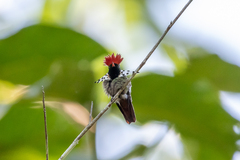
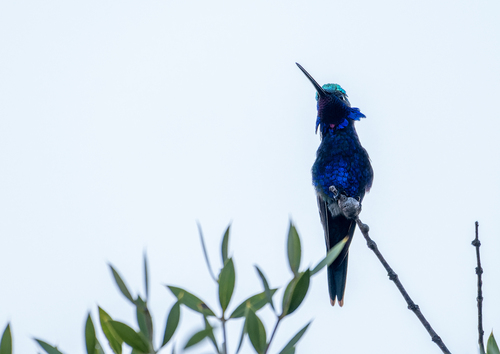
The dot-eared coquette (Lophornis gouldii) is a species of hummingbird in the "coquettes", tribe Lesbiini of subfamily Lesbiinae. It is found in Bolivia and Brazil. The dot-eared coquette is monotypic. The dot-eared coquette is 6.8 to 7.6 cm (2.7 to 3.0 in) long and weighs 2.4 to 2.8 g (0.085 to 0.099 oz). Both sexes have a short, straight, black-tipped red bill. The adult male's forehead is glittering golden green. Long dark rufous feathers on its crown form a crest. Its upperparts are bronzy green with a white band across the rump. Its throat is glittering emerald green. Long white feathers with shiny green dots make tufts that fan out and back on the cheeks. Its underparts are grayish green. Its central tail feathers are bronzy green and the rest rufous with bronzy green tips and edges. The adult female does not have the male's crest or cheek tufts. Its upperparts are colored like the male's but with a bronzy iridescence. Its throat is rufous with a grayish green lower border. Its tail is bronze with rufous tips. Juveniles are similar to the adult female.

The dot-eared coquette is found primarily in Brazil... Wikipedia →

Sounds

Call0:10

Brazil · 2012

© Andrew Spencer · XC168727 · CC BY-NC-SA 3.0

Global Distribution

Parks Where Found

# Park Country Daily sighting probability
1 Chapada dos Guimarães National Park 🇧🇷 Brazil
<5%

More parks will be added in future updates.

Before you go

What are the chances of seeing a Dot-eared Coquette in Chapada dos Guimarães National Park?

Rare

Under 5% of wildlife watchers report a Dot-eared Coquette sighting in Chapada dos Guimarães National Park on a given day, based on 34 verified sightings from GBIF citizen-science data from 2019 to 2026. It is the 166th most-seen of the 273 birds we can rate there. Over three days the chance rises to about 10%, and over a week to about 30%, if each day is a fresh chance.

When is the best time to see a Dot-eared Coquette in Chapada dos Guimarães National Park?

June and September–October

In those months about 10% of wildlife watchers report a Dot-eared Coquette in Chapada dos Guimarães National Park on a given day, against under 5% in May, July–August and November–January, the lowest months. Those are among Chapada dos Guimarães National Park's driest months, with about 50 mm of rain a month against 240 mm in March. February to April have too few records to rate.

What time of day is best to see a Dot-eared Coquette?

Between 9 am and noon

Across all the parks we cover, that three-hour window holds the most Dot-eared Coquette sightings with a recorded time, and nearly all of them come between 6 am and 6 pm: it is a daytime animal.

Where else can you see a Dot-eared Coquette?

Only Chapada dos Guimarães National Park, in our data

Chapada dos Guimarães National Park is the only park on Wallace's Line with enough records to rate Dot-eared Coquette sightings: under 5% of wildlife watchers there report one on a given day.

Where does the Dot-eared Coquette sighting chance come from?

GBIF citizen-science records

It is estimated from how often the Dot-eared Coquette is recorded against all the birds logged in Chapada dos Guimarães National Park (34 verified sightings from 2019 to 2026), calibrated against known sighting rates. Figures are rounded to the nearest 10% because citizen-science data supports honest approximations, not decimals, and months with records from fewer than five people show "—". How it works.

← Back to Chapada dos Guimarães National Park