Apolinar's Wren

Apolinar's Wren

Cistothorus apolinari

Silhouette: Matt Wilkins · PhyloPic

LCNTVUENEndangeredCR Endemic
Daily sighting probability <5% · Rare
at Chingaza National Natural Park

In 3 days <5%

7 Verified sightings at Chingaza National Natural Park From 2019 to 2026
7 In 1 park
January Best month
☀️ Diurnal When it's spotted

About the Apolinar's Wren

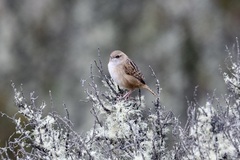
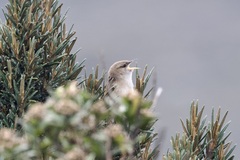
Apolinar's wren (Cistothorus apolinari) is a passerine bird in the family Troglodytidae. It is endemic to Colombia. Apolinar's wren has two subspecies, the nominate Cistothorus apolinari apolinari and C. a. hernandezi. The latter was described in 2002 and has been suggested to be a separate species. Apolinar's wren, grass wren (C. platensis), and Mérida wren (C. meridae) form a superspecies.

The common and scientific names of Apolinar's wren commemorate the Colombian monk Brother Apolinar Maria (1877–1949) who was also an ornithologist. Its Spanish common name is cucarachero de pantano (literally, swamp cockroach hunter).

Apolinar's wren is 12 cm (4.7 in) long. A male C. a. hernandezi weighed 17.7 g (0.62 oz). Nominate adults have a chestnut crown, blackish brown shoulders and upper back with whitish buff streaks, and bright reddish brown lower back and rump. Their tails are reddish with blackish brown barring. They have a faint supercilium that is a bit lighter than the rest of the gray-brown face. Their underparts are buff-brown that is lighter on the throat and more reddish on the lower flanks. The juvenile's head is dark gray-brown... Wikipedia →

Sounds

Song1:16

Colombia · 2022

© Frank Lambert · XC1031694 · CC BY-NC-ND 4.0

Call0:49

Colombia · 2021

© Peter Boesman · XC693426 · CC BY-NC-ND 4.0

Duet0:29

Colombia · 2015

© David Ricardo Rodríguez Villamil · XC291856 · CC BY-NC-SA 4.0

Global Distribution

Parks Where Found

# Park Country Daily sighting probability
1 Chingaza National Natural Park 🇨🇴 Colombia
<5%

More parks will be added in future updates.

Before you go

What are the chances of seeing an Apolinar's Wren in Chingaza National Natural Park?

Rare

Under 5% of wildlife watchers report an Apolinar's Wren sighting in Chingaza National Natural Park on a given day, based on 7 verified sightings from GBIF citizen-science data from 2019 to 2026. It is the 221st most-seen of the 258 birds we can rate there. Over three days the chance rises to under 5%, if each day is a fresh chance.

When is the best time to see an Apolinar's Wren in Chingaza National Natural Park?

Any time of year

In every month with enough records, under 5% of wildlife watchers report an Apolinar's Wren in Chingaza National Natural Park on a given day, so our monthly data shows no clear season.

What time of day is best to see an Apolinar's Wren?

Between 8 and 11 am

Across all the parks we cover, that three-hour window holds the most Apolinar's Wren sightings with a recorded time, and about 8 in 10 of them come between 6 am and 6 pm: it is a daytime animal.

Where else can you see an Apolinar's Wren?

Only Chingaza National Natural Park, in our data

Chingaza National Natural Park is the only park on Wallace's Line with enough records to rate Apolinar's Wren sightings: under 5% of wildlife watchers there report one on a given day.

Where does the Apolinar's Wren sighting chance come from?

GBIF citizen-science records

It is estimated from how often the Apolinar's Wren is recorded against all the birds logged in Chingaza National Natural Park (7 verified sightings from 2019 to 2026), calibrated against known sighting rates. Figures are rounded to the nearest 10% because citizen-science data supports honest approximations, not decimals, and months with records from fewer than five people show "—". How it works.

← Back to Chingaza National Natural Park