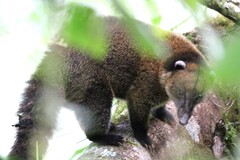
Mountain Coati

Mountain Coati

Nasua olivacea

Silhouette: Margot Michaud · PhyloPic

LCNTNear ThreatenedVUENCR
Daily sighting probability ~10% · With luck
at Chingaza National Natural Park

In 3 days ~30% in a week ~60%

25 Verified sightings at Chingaza National Natural Park From 2019 to 2026
25 In 1 park
July Best month
☀️ Diurnal When it's spotted

About the Mountain Coati

The western mountain coati or western dwarf coati (Nasuella olivacea) is a small procyonid, found in cloud forest and páramo at altitudes of 1,300–4,250 metres (4,270–13,940 ft) in the Andes of Colombia and Ecuador. A population discovered in the Apurímac–Cuzco region of southern Peru (more than 1,000 km or 620 mi south of the previous distribution limit) has tentatively been identified as the western mountain coati, but may represent an undescribed taxon.

Until 2009, the western mountain coati (then simply known as the mountain coati) usually included the eastern mountain coati as a subspecies, but that species is overall smaller, somewhat shorter-tailed on average, has markedly smaller teeth, a paler olive-brown pelage, and usually a dark mid-dorsal stripe on the back (versus more rufescent or blackish, and usually without a dark mid-dorsal stripe in the western mountain coati). When the two were combined, they were rated as Data Deficient by the IUCN, but following the split the western mountain coati is considered Near Threatened. After a genetic analysis in 2020, the American Society of Mammalogists currently considers N. meridensis a synonym of N. olivacea.

The former is known from Colombia and the latter from Ecuador, but the exact distribution limit between the two is not known. Wikipedia →

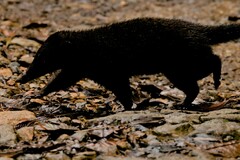
Global Distribution

Parks Where Found

# Park Country Daily sighting probability
1 Chingaza National Natural Park 🇨🇴 Colombia
~10%

More parks will be added in future updates.

Zoos & Centres Where Found

# Zoo / Centre Country
1 Amaru 🇪🇨 Ecuador In captivity
2 Ecozoológico San Martín 🇪🇨 Ecuador In captivity
3 zoologico de barranquilla 🇨🇴 Colombia In captivity
4 Wiwa Quito 🇪🇨 Ecuador In captivity

Before you go

What are the chances of seeing a Mountain Coati in Chingaza National Natural Park?

With luck

About 10% of wildlife watchers report a Mountain Coati sighting in Chingaza National Natural Park on a given day, based on 25 verified sightings from GBIF citizen-science data from 2019 to 2026. It is the 5th most-seen of the 5 mammals we can rate there. Over three days the chance rises to about 30%, and over a week to about 60%, if each day is a fresh chance.

When is the best time to see a Mountain Coati in Chingaza National Natural Park?

January, April and July

In those months about 20% of wildlife watchers report a Mountain Coati in Chingaza National Natural Park on a given day, against under 5% in May, the lowest month.

What time of day is best to see a Mountain Coati?

Between 8 and 11 am

Across all the parks we cover, that three-hour window holds the most Mountain Coati sightings with a recorded time, and about 7 in 10 of them come between 6 am and 6 pm: it is a daytime animal.

Where else can you see a Mountain Coati?

Only Chingaza National Natural Park, in our data

Chingaza National Natural Park is the only park on Wallace's Line with enough records to rate Mountain Coati sightings: about 10% of wildlife watchers there report one on a given day.

Where does the Mountain Coati sighting chance come from?

GBIF citizen-science records

It is estimated from how often the Mountain Coati is recorded against all the mammals logged in Chingaza National Natural Park (25 verified sightings from 2019 to 2026), calibrated against known sighting rates. Figures are rounded to the nearest 10% because citizen-science data supports honest approximations, not decimals, and months with records from fewer than five people show "—". How it works.

← Back to Chingaza National Natural Park