Black-legged Mongoose

Black-legged Mongoose

Bdeogale nigripes

Silhouette: Margot Michaud · PhyloPic

LCLeast ConcernNTVUENCR
Daily sighting probability ~30% · Possible
at Chinko Conservation Area

In 3 days ~70% in a week ~90%

21 Verified sightings at Chinko Conservation Area From 2019 to 2026
21 In 1 park
February Best month
🌙 Nocturnal When it's spotted

About the Black-legged Mongoose

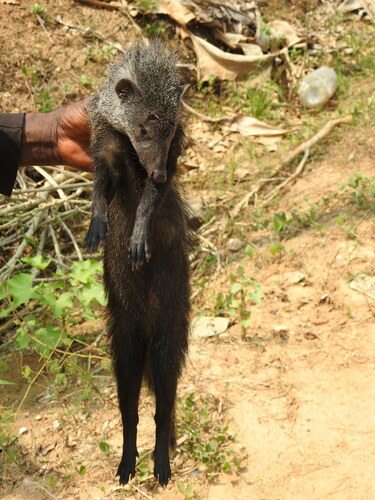
The black-footed mongoose (Bdeogale nigripes), also called the black-legged mongoose, is a mongoose species native to Central Africa, where it inhabits deep deciduous forests from eastern Nigeria to the southern Democratic Republic of the Congo. It has been listed as Least Concern on the IUCN Red List since 2008.

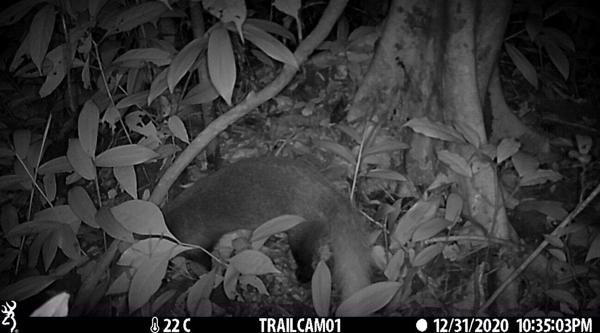
It is omnivorous and feeds on ants, termites, Orthoptera, small rodents, frogs, lizards and fruits. It is mostly solitary and nocturnal. Results of genetic and morphological analyses indicate that the black-footed mongoose is closely related to Jackson's mongoose, which is considered conspecific.

Black-footed mongoose have a blunt muzzle and short limbs. They have a grayish-brown grizzled coat with black legs. Their coat consists of long coarse guard hairs with a soft undercoat. Adults have a 375-to-600-millimetre (14.8 to 23.6 in) body length, stand 175 to 375 millimetres (6.9 to 14.8 in) high at the shoulders, and have a 6.8-to-14.7-inch (170 to 370 mm) long tail. Adults weigh between 900 and 3,000 grams (2.0 and 6.6 lb).
Wikipedia →

Global Distribution

Parks Where Found

# Park Country Daily sighting probability
1 Chinko Conservation Area 🇨🇫 Central African Republic
~30%

More parks will be added in future updates.

Before you go

What are the chances of seeing a Black-legged Mongoose in Chinko Conservation Area?

Possible

About 30% of wildlife watchers report a Black-legged Mongoose sighting in Chinko Conservation Area on a given day, based on 21 verified sightings from GBIF citizen-science data from 2019 to 2026. It is the 26th most-seen of the 53 mammals we can rate there. Over three days the chance rises to about 70%, and over a week to about 90%, if each day is a fresh chance.

When is the best time to see a Black-legged Mongoose in Chinko Conservation Area?

February

In that month about 60% of wildlife watchers report a Black-legged Mongoose in Chinko Conservation Area on a given day, against under 5% in May–June and August–September, the lowest months. That is one of Chinko Conservation Area's driest months, with almost no rain against 180 mm in August.

What time of day is best to see a Black-legged Mongoose?

Between 8 and 11 pm

Across all the parks we cover, that three-hour window holds the most Black-legged Mongoose sightings with a recorded time, and about 9 in 10 of them come between 6 pm and 6 am: it is mostly seen at night.

Where else can you see a Black-legged Mongoose?

Only Chinko Conservation Area, in our data

Chinko Conservation Area is the only park on Wallace's Line with enough records to rate Black-legged Mongoose sightings: about 30% of wildlife watchers there report one on a given day.

Which relatives of the Black-legged Mongoose live in Chinko Conservation Area?

Same family: Herpestidae

The closest relatives of the Black-legged Mongoose that you can see in Chinko Conservation Area (family Herpestidae, Mongooses) are White-tailed Mongoose (about 40%), Marsh Mongoose (about 20%) and Banded Mongoose (about 20%), with each one's daily chance of a sighting.

Where does the Black-legged Mongoose sighting chance come from?

GBIF citizen-science records

It is estimated from how often the Black-legged Mongoose is recorded against all the mammals logged in Chinko Conservation Area (21 verified sightings from 2019 to 2026), calibrated against known sighting rates. Figures are rounded to the nearest 10% because citizen-science data supports honest approximations, not decimals, and months with records from fewer than five people show "—". How it works.

← Back to Chinko Conservation Area