Gray-headed Batis

Gray-headed Batis

Batis orientalis

Silhouette: Mathieu Pélissié · PhyloPic

LCLeast ConcernNTVUENCR
Daily sighting probability ~20% · Possible
at Chinko Conservation Area

In 3 days ~40% in a week ~70%

6 Verified sightings at Chinko Conservation Area From 2019 to 2026
64 In all 3 parks
February Best month
☀️ Diurnal When it's spotted

About the Gray-headed Batis

The grey-headed batis (Batis orientalis) is a species of bird in the wattle-eyes family, Platysteiridae, it was previously classified with the Old World flycatchers in the family Muscicapidae. It is found in eastern and central Africa.

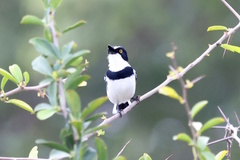
The grey headed batis is a small grey, black and white bird with restless habits. In the adult males the forehead, crown and nape are bluish black, there is a small white loral spot which extends into a long, broad, supercilium, there is a small white patch on the nape and the face mask is glossy black. The mantle and back are dark grey with a tinge of glossy black, the fluffy rump is white and the uppertail coverts are black. The wing is black with a white stripe and the tail is black with white outer tail feathers. The underparts are white, except for a glossy black breast band and blackish underwing coverts. The female is similar to the male but has a chestnut or rufous breast band. It has yellow eyes, a black bill and black legs. The grey-headed batis measures 10–11 cm (3.9–4.3 in) in length and weighs 8.8–13.4 g (0.31–0.47 oz).

It is found in western central and east Africa from Niger and Nigeria...

Wikipedia →

Sounds

Song0:30

Ethiopia · 2019

© Barry Edmonston · XC530754 · CC BY-NC-SA 4.0

Call0:20

Ethiopia · 2015

© Peter Boesman · XC299982 · CC BY-NC-ND 4.0

Song0:25

Ethiopia · 2014

© Andrew Spencer · XC244614 · CC BY-NC-SA 4.0

Global Distribution

Parks Where Found

# Park Country Daily sighting probability
1 Awash National Park 🇪🇹 Ethiopia
~30%
2 Chinko Conservation Area 🇨🇫 Central African Republic
~20%
3 Kidepo Valley National Park 🇺🇬 Uganda
~10%

Before you go

What are the chances of seeing a Gray-headed Batis in Chinko Conservation Area?

Possible

About 20% of wildlife watchers report a Gray-headed Batis sighting in Chinko Conservation Area on a given day, based on 6 verified sightings from GBIF citizen-science data from 2019 to 2026. It is the 24th most-seen of the 47 birds we can rate there. Over three days the chance rises to about 40%, and over a week to about 70%, if each day is a fresh chance.

When is the best time to see a Gray-headed Batis in Chinko Conservation Area?

January and February

In those months about 30% of wildlife watchers report a Gray-headed Batis in Chinko Conservation Area on a given day, against under 5% in April to November, the lowest months. Those are among Chinko Conservation Area's driest months, with almost no rain against 180 mm in August.

What time of day is best to see a Gray-headed Batis?

Between 3 and 6 pm

Across all the parks we cover, that three-hour window holds the most Gray-headed Batis sightings with a recorded time, and about 9 in 10 of them come between 6 am and 6 pm: it is a daytime animal.

Is Chinko Conservation Area the best place to see a Gray-headed Batis?

2nd of 3

Of the 3 parks where we can rate Gray-headed Batis sightings, Chinko Conservation Area ranks 2nd at about 20%. The best odds are in Awash National Park (Ethiopia, about 30%).

Which relatives of the Gray-headed Batis live in Chinko Conservation Area?

Same order: Passeriformes

The closest relatives of the Gray-headed Batis that you can see in Chinko Conservation Area (order Passeriformes, Perching Birds) are Fork-tailed Drongo (about 60%), Common Bulbul (about 50%) and Sooty Chat (about 50%), with each one's daily chance of a sighting.

Where does the Gray-headed Batis sighting chance come from?

GBIF citizen-science records

It is estimated from how often the Gray-headed Batis is recorded against all the birds logged in Chinko Conservation Area (6 verified sightings from 2019 to 2026), calibrated against known sighting rates. Figures are rounded to the nearest 10% because citizen-science data supports honest approximations, not decimals, and months with records from fewer than five people show "—". How it works.

← Back to Chinko Conservation Area