Sooty Chat

Sooty Chat

Myrmecocichla nigra

Silhouette: Martin Bulla, based on François Desbordes' illustration · PhyloPic

LCLeast ConcernNTVUENCR
Daily sighting probability ~50% · Likely
at Chinko Conservation Area

In 3 days ~90% in a week >90%

24 Verified sightings at Chinko Conservation Area From 2019 to 2026
3,666 In all 16 parks
☀️ Diurnal When it's spotted

About the Sooty Chat

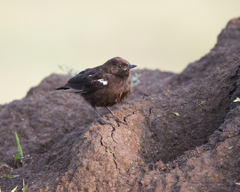
The sooty chat (Myrmecocichla nigra) is an African songbird of the chat subfamily. It is 15 to 16 cm (6 to 6.25 inches) long, stocky and relatively short-tailed for a chat. The adult male's plumage is glossy black except for white patches on the upper wings that are usually visible or only partly concealed (as in the photograph at upper right) when the bird is at rest. The female and young are very dark brown.

The song (in Kenya and northern Tanzania) is described as "prolonged, sweet and musical, sometimes given in flight, wee tewee tuweer, skwik-skueeeeer, cueee-eeeee-cuweeeeer, eee-euwee-tee, tseuwee-tew-skweeer-tsi-seet…." This species sometimes imitates other birds.

It occurs widely but discontinuously in African grasslands, from Senegal east to Kenya and south to Angola and Zambia. Its range is estimated at 3,400,000 km2, and it is considered "frequent" in at least parts of that area.

Wikipedia →

Sounds

Song0:17

Uganda · 2022

© Peter Boesman · XC739850 · CC BY-NC-ND 4.0

Recording1:01

Central African Republic · 2021

© Mathias D'haen · XC674432 · CC BY-NC-SA 4.0

Call0:11

Congo (Democratic Republic) · 2017

© Bram Piot · XC361790 · CC BY-NC-SA 4.0

Global Distribution

Parks Where Found

# Park Country Daily sighting probability
1 Kidepo Valley National Park 🇺🇬 Uganda
~60%
2 Akagera National Park 🇷🇼 Rwanda
~50%
3 Chinko Conservation Area 🇨🇫 Central African Republic
~50%
4 Masai Mara National Reserve 🇰🇪 Kenya
~40%
5 Lake Mburo National Park 🇺🇬 Uganda
~30%
6 Queen Elizabeth National Park 🇺🇬 Uganda
~30%
7 Odzala-Kokoua National Park 🇨🇬 Republic of the Congo
~30%
8 Murchison Falls National Park 🇺🇬 Uganda
~20%
9 Virunga National Park 🇨🇩 Democratic Republic of the Congo
~10%
10 Kafue National Park 🇿🇲 Zambia
~10%
11 Serengeti National Park 🇹🇿 Tanzania
~10%
12 Semuliki National Park 🇺🇬 Uganda
<5%
13 Nyungwe National Park 🇷🇼 Rwanda
<5%
14 Ngorongoro Conservation Area 🇹🇿 Tanzania
<5%
15 Kibale National Park 🇺🇬 Uganda
<5%
16 Bwindi Impenetrable National Park 🇺🇬 Uganda
<5%

Cities Where Found

# City Country Daily sighting probability
1 Kampala 🇺🇬 Uganda
<5%

Before you go

What are the chances of seeing a Sooty Chat in Chinko Conservation Area?

Likely

About 50% of wildlife watchers report a Sooty Chat sighting in Chinko Conservation Area on a given day, based on 24 verified sightings from GBIF citizen-science data from 2019 to 2026. It is the 3rd most-seen of the 47 birds we can rate there. Over three days the chance rises to about 90%, and over a week to over 90%, if each day is a fresh chance.

What time of day is best to see a Sooty Chat?

Between 7 and 10 am

Across all the parks we cover, that three-hour window holds the most Sooty Chat sightings with a recorded time, and about 8 in 10 of them come between 6 am and 6 pm: it is a daytime animal.

Which relatives of the Sooty Chat live in Chinko Conservation Area?

Same family: Muscicapidae

The closest relatives of the Sooty Chat that you can see in Chinko Conservation Area (family Muscicapidae, Old World Flycatchers, Robins, and Chats) are White-fronted Black Chat (about 20%), Familiar Chat (about 20%) and African Dusky Flycatcher (about 20%), with each one's daily chance of a sighting.

Where does the Sooty Chat sighting chance come from?

GBIF citizen-science records

It is estimated from how often the Sooty Chat is recorded against all the birds logged in Chinko Conservation Area (24 verified sightings from 2019 to 2026), calibrated against known sighting rates. Figures are rounded to the nearest 10% because citizen-science data supports honest approximations, not decimals, and months with records from fewer than five people show "—". How it works.

← Back to Chinko Conservation Area