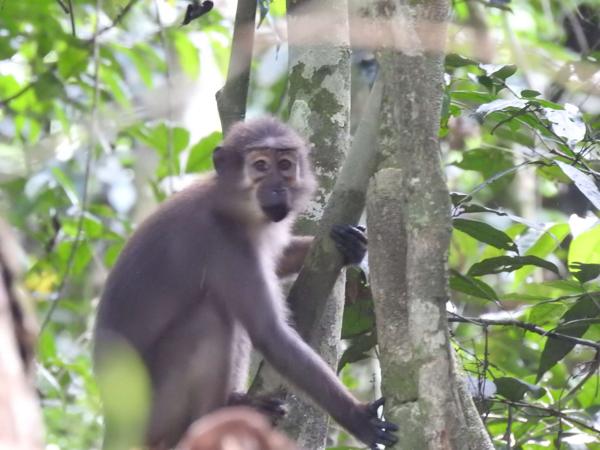
Tantalus Monkey

Tantalus Monkey

Chlorocebus tantalus

Silhouette: PhyloPic

LCLeast ConcernNTVUENCR
Daily sighting probability ~20% · Possible
at Chinko Conservation Area

In 3 days ~50% in a week ~80%

10 Verified sightings at Chinko Conservation Area From 2019 to 2026
87 In all 3 parks
April Best month
☀️ Diurnal When it's spotted

About the Tantalus Monkey

The tantalus monkey (Chlorocebus tantalus) is an Old World monkey from Africa that ranges from Ghana to Sudan. It was originally described as a subspecies of the grivet (Chlorocebus aethiops). All species in Chlorocebus were formerly in the genus Cercopithecus. It is a common species with a wide range, and the International Union for Conservation of Nature has rated its conservation status as being of "least concern".

This species has three recognized subspecies: C. t. tantalus C. t. marrensis A medium-sized species, the tantalus monkey has a black face and a long tail. There is a distinctive undulating white or yellowish browband above the eyes. The cheeks and temples are white, the long hairs being swept backwards and often covering the ears in older individuals. The crown and dorsal surface of the body is grizzled and greenish or golden. The underparts are white and the tail and outer surfaces of the limbs grey. The tail may have a whitish tip. The male is larger than the female and has a bright blue scrotum surrounded by orange hairs.

This monkey is found in tropical central Africa. Its native range...

Wikipedia →

Sounds

Call0:35

Chad · 2024

© Julien Birard · XC960767 · CC BY-NC-SA 4.0

Global Distribution

Parks Where Found

# Park Country Daily sighting probability
1 Queen Elizabeth National Park 🇺🇬 Uganda
~50%
2 Murchison Falls National Park 🇺🇬 Uganda
~30%
3 Chinko Conservation Area 🇨🇫 Central African Republic
~20%

Cities Where Found

# City Country Daily sighting probability
1 Kampala 🇺🇬 Uganda
~30%

Zoos & Centres Where Found

# Zoo / Centre Country
1 Jardín Zoológico El Bosque 🇨🇺 Cuba In captivity
2 Imo State Zoological Garden 🇳🇬 Nigeria In captivity

Before you go

What are the chances of seeing a Tantalus Monkey in Chinko Conservation Area?

Possible

About 20% of wildlife watchers report a Tantalus Monkey sighting in Chinko Conservation Area on a given day, based on 10 verified sightings from GBIF citizen-science data from 2019 to 2026. It is the 46th most-seen of the 53 mammals we can rate there. Over three days the chance rises to about 50%, and over a week to about 80%, if each day is a fresh chance.

When is the best time to see a Tantalus Monkey in Chinko Conservation Area?

April and August

In those months about 40% of wildlife watchers report a Tantalus Monkey in Chinko Conservation Area on a given day, against under 5% in March, June–July and September–December, the lowest months. Those are among Chinko Conservation Area's wettest months, with about 120 mm of rain a month against almost none in January.

What time of day is best to see a Tantalus Monkey?

Between 9 am and noon

Across all the parks we cover, that three-hour window holds the most Tantalus Monkey sightings with a recorded time, and about 8 in 10 of them come between 6 am and 6 pm: it is a daytime animal.

Is Chinko Conservation Area the best place to see a Tantalus Monkey?

3rd of 3

Of the 3 parks where we can rate Tantalus Monkey sightings, Chinko Conservation Area ranks 3rd at about 20%. The best odds are in Queen Elizabeth National Park (Uganda, about 50%) and Murchison Falls National Park (Uganda, about 30%).

Which relatives of the Tantalus Monkey live in Chinko Conservation Area?

Same family: Cercopithecidae

The closest relatives of the Tantalus Monkey that you can see in Chinko Conservation Area (family Cercopithecidae, Old World Monkeys) are Olive Baboon (about 60%), Mantled Guereza (about 50%) and Putty-nosed Monkey (about 40%), with each one's daily chance of a sighting.

Where does the Tantalus Monkey sighting chance come from?

GBIF citizen-science records

It is estimated from how often the Tantalus Monkey is recorded against all the mammals logged in Chinko Conservation Area (10 verified sightings from 2019 to 2026), calibrated against known sighting rates. Figures are rounded to the nearest 10% because citizen-science data supports honest approximations, not decimals, and months with records from fewer than five people show "—". How it works.

← Back to Chinko Conservation Area