Agile Mangabey

Agile Mangabey

Cercocebus agilis

Silhouette: PhyloPic

LCLeast ConcernNTVUENCR
Daily sighting probability ~20% · Possible
at Chinko Conservation Area

In 3 days ~40% in a week ~70%

7 Verified sightings at Chinko Conservation Area From 2019 to 2026
23 In all 2 parks
April Best month
☀️ Diurnal When it's spotted

About the Agile Mangabey

The agile mangabey (Cercocebus agilis) is an Old World monkey of the white-eyelid mangabey group found in swampy forests of Central Africa in Equatorial Guinea, Cameroon, Gabon, Central African Republic, Republic of Congo, and DR Congo. Until 1978, it was considered a subspecies of the Tana River mangabey (C. galeritus). More recently, the golden-bellied mangabey (C. chrysogaster) has been considered a separate species instead of a subspecies of the agile mangabey.

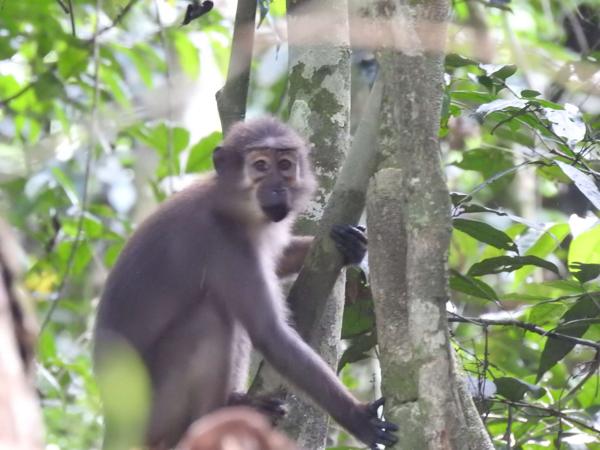
The agile mangabey has a short, overall dull olive-grey pelage. The bare skin of the face and feet is blackish. Males are 51–65 centimeters (20–26 inches) in length and weigh about 7–13 kilograms (15–29 lb), while the smaller females are 44–55 centimeters (17–22 inches) and weigh 5–7 kilograms (11–15 lb).

Similar to other mangabeys, they are diurnal. Although generally arboreal, they do spend a significant portion of their time (12–22%) on the ground, especially during the dry season. It is typically more commonly heard than seen, and males have a loud, species-specific call that is believed to be used to space themselves out. Other calls are also used to maintain group cohesion...

Wikipedia →

Sounds

Uncertain0:56

Central African Republic · 2026

© Antoine Ede · XC1090949 · CC BY-NC-SA 4.0

Global Distribution

Parks Where Found

# Park Country Daily sighting probability
1 Odzala-Kokoua National Park 🇨🇬 Republic of the Congo
~30%
2 Chinko Conservation Area 🇨🇫 Central African Republic
~20%

Zoos & Centres Where Found

# Zoo / Centre Country
1 Limbe Wildlife Centre 🇨🇲 Cameroon In captivity

Before you go

What are the chances of seeing an Agile Mangabey in Chinko Conservation Area?

Possible

About 20% of wildlife watchers report an Agile Mangabey sighting in Chinko Conservation Area on a given day, based on 7 verified sightings from GBIF citizen-science data from 2019 to 2026. It is the 50th most-seen of the 53 mammals we can rate there. Over three days the chance rises to about 40%, and over a week to about 70%, if each day is a fresh chance.

When is the best time to see an Agile Mangabey in Chinko Conservation Area?

April

In that month about 40% of wildlife watchers report an Agile Mangabey in Chinko Conservation Area on a given day, against under 5% in July–August and October–February, the lowest months.

What time of day is best to see an Agile Mangabey?

Between 9 am and noon

Across all the parks we cover, that three-hour window holds the most Agile Mangabey sightings with a recorded time, and nearly all of them come between 6 am and 6 pm: it is a daytime animal.

Is Chinko Conservation Area the best place to see an Agile Mangabey?

2nd of 2

Of the 2 parks where we can rate Agile Mangabey sightings, Chinko Conservation Area ranks 2nd at about 20%. The best odds are in Odzala-Kokoua National Park (Republic of the Congo, about 30%).

Which relatives of the Agile Mangabey live in Chinko Conservation Area?

Same family: Cercopithecidae

The closest relatives of the Agile Mangabey that you can see in Chinko Conservation Area (family Cercopithecidae, Old World Monkeys) are Olive Baboon (about 60%), Mantled Guereza (about 50%) and Putty-nosed Monkey (about 40%), with each one's daily chance of a sighting.

Where does the Agile Mangabey sighting chance come from?

GBIF citizen-science records

It is estimated from how often the Agile Mangabey is recorded against all the mammals logged in Chinko Conservation Area (7 verified sightings from 2019 to 2026), calibrated against known sighting rates. Figures are rounded to the nearest 10% because citizen-science data supports honest approximations, not decimals, and months with records from fewer than five people show "—". How it works.

← Back to Chinko Conservation Area
