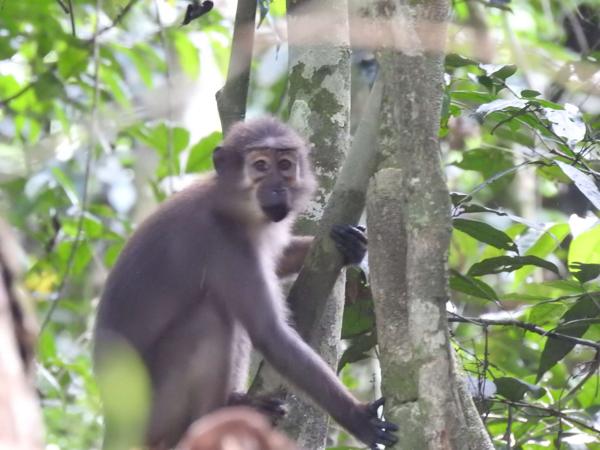
Putty-nosed Monkey

Putty-nosed Monkey

Cercopithecus nictitans

LCNTNear ThreatenedVUENCR
Daily sighting probability ~40% · Likely
at Chinko Conservation Area

In 3 days ~80% in a week >90%

27 Verified sightings at Chinko Conservation Area From 2019 to 2026
49 In all 2 parks
December Best month
☀️ Diurnal When it's spotted

About the Putty-nosed Monkey

The greater spot-nosed monkey or putty-nosed monkey (Cercopithecus nictitans) is one of the smallest Old World monkeys. It is a guenon of the C. mitis group, native to West Africa and living to some extent in rain forests, but more often in the transition zone between rain forest and savannah. It is primarily arboreal and often associates with monkeys of other species. Both their common names come from the monkeys' prominent white nose.

The greater spot-nosed monkey lives in groups consisting of one adult male, a number of adult females, and their dependent offspring. Little recent research has been conducted into its behaviour, and most has concentrated on its auditory communication. Males use three call types which have been described as 'booms', 'pyows', and 'hacks'. These are used in a number of contexts including as alarm calls.

As in some other species of monkeys, the acoustical structure of greater spot-nosed monkey alarm calls it has been argued to vary according to the kind of predator spotted. The monkey reportedly combines different sounds into a sequence, which has an entirely different meaning from the sounds out of which it is made.

Wikipedia →

Sounds

Recording0:25

Gabon · 2022

© BurBenj · XC1133108 · CC BY-NC-SA 4.0

Recording0:08

Gabon · 2022

© bureaubenjamin · iNaturalist · CC BY-NC 4.0

Recording0:18

Congo - Brazzaville · 2023

© Gwili Gibbon · iNaturalist · CC BY-NC 4.0

Global Distribution

Parks Where Found

# Park Country Daily sighting probability
1 Chinko Conservation Area 🇨🇫 Central African Republic
~40%
2 Odzala-Kokoua National Park 🇨🇬 Republic of the Congo
~40%

Zoos & Centres Where Found

# Zoo / Centre Country
1 Barcelona Zoo 🇪🇸 Spain In captivity
2 Dvůr Králové Zoo 🇨🇿 Czechia In captivity
3 Berlin Zoological Garden 🇩🇪 Germany In captivity
4 Aquarama Barcelona 🇪🇸 Spain In captivity
5 Animal Orphanage 🇰🇪 Kenya In captivity
6 Aquarium Berlin 🇩🇪 Germany In captivity

Before you go

What are the chances of seeing a Putty-nosed Monkey in Chinko Conservation Area?

Likely

About 40% of wildlife watchers report a Putty-nosed Monkey sighting in Chinko Conservation Area on a given day, based on 27 verified sightings from GBIF citizen-science data from 2019 to 2026. It is the 23rd most-seen of the 53 mammals we can rate there. Over three days the chance rises to about 80%, and over a week to over 90%, if each day is a fresh chance.

When is the best time to see a Putty-nosed Monkey in Chinko Conservation Area?

February–March and December

In those months about 50% of wildlife watchers report a Putty-nosed Monkey in Chinko Conservation Area on a given day, against under 5% in April and September, the lowest months. Those are among Chinko Conservation Area's driest months, with about 10 mm of rain a month against 180 mm in August.

What time of day is best to see a Putty-nosed Monkey?

Between 6 and 9 am

Across all the parks we cover, that three-hour window holds the most Putty-nosed Monkey sightings with a recorded time, and nearly all of them come between 6 am and 6 pm: it is a daytime animal.

Is Chinko Conservation Area the best place to see a Putty-nosed Monkey?

Yes

Of the 2 parks where we can rate Putty-nosed Monkey sightings, Chinko Conservation Area has the highest daily chance: about 40%. Next come Odzala-Kokoua National Park (Republic of the Congo, about 40%).

Which relatives of the Putty-nosed Monkey live in Chinko Conservation Area?

Same genus: Cercopithecus

The closest relatives of the Putty-nosed Monkey that you can see in Chinko Conservation Area (genus Cercopithecus, Guenons) are De Brazza’s Monkey (about 30%), Red-tailed Monkey (about 30%) and Crowned Monkey (about 20%), with each one's daily chance of a sighting.

Where does the Putty-nosed Monkey sighting chance come from?

GBIF citizen-science records

It is estimated from how often the Putty-nosed Monkey is recorded against all the mammals logged in Chinko Conservation Area (27 verified sightings from 2019 to 2026), calibrated against known sighting rates. Figures are rounded to the nearest 10% because citizen-science data supports honest approximations, not decimals, and months with records from fewer than five people show "—". How it works.

← Back to Chinko Conservation Area