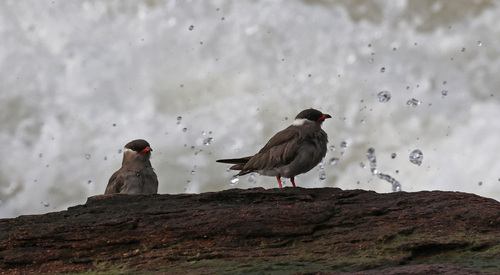
Black-winged Pratincole

Black-winged Pratincole

Glareola nordmanni

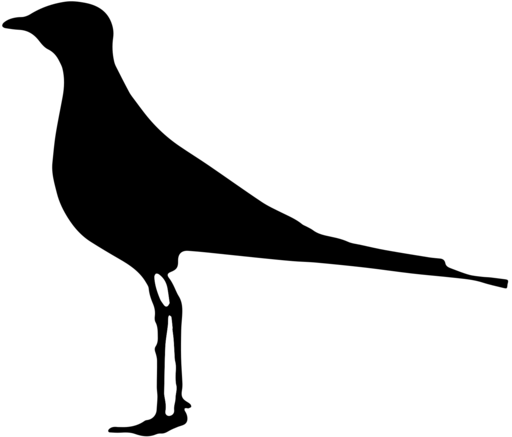
Silhouette: Cristian Gutierrez-Ibanez · PhyloPic

LCNTNear ThreatenedVUENCR
Daily sighting probability <5% · Rare
at Chobe National Park

In 3 days ~10% in a week ~30%

64 Verified sightings at Chobe National Park From 2019 to 2026
160 In all 5 parks
December Best month
☀️ Diurnal When it's spotted

About the Black-winged Pratincole

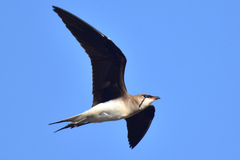
The black-winged pratincole (Glareola nordmanni) is a wader in the pratincole bird family, Glareolidae. The genus name is a diminutive of Latin glarea, "gravel", referring to a typical nesting habitat for pratincoles. The species name commemorates the Finnish-born zoologist and explorer Alexander von Nordmann.

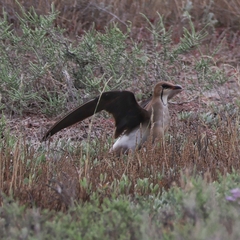
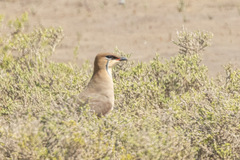
It is 24–28 cm (9.4–11.0 in) long, with short legs, long pointed wings and a forked tail. It has a short bill, which is an adaptation to aerial feeding. The back and head are brown, and the wings are brown with black flight feathers. The belly is white and the underwings are black. Very good views are needed to distinguish this species from other pratincoles, such as the collared pratincole and the oriental pratincole which may occur in its range. It is marginally larger than the collared pratincole, and is shorter-tailed and longer legged. Although the dark underwing and lack of a white trailing edge to the wing are diagnostic, these features are not always readily seen in the field, especially as the chestnut underwing of the collared pratincole appears black unless excellent views are obtained.

The black-winged pratincole is... Wikipedia →

Sounds

Flight call0:12

Kazakhstan · 2025

© Frank Lambert · XC1031152 · CC BY-NC-ND 4.0

Call0:34

Kazakhstan · 2023

© Peter Boesman · XC813415 · CC BY-NC-ND 4.0

Alarm call0:13

Russian Federation · 2004

© Vladimir Arkhipov · XC304519 · CC BY-NC-SA 4.0

Global Distribution

Parks Where Found

# Park Country Daily sighting probability
1 Chobe National Park 🇧🇼 Botswana
<5%
2 Moremi Game Reserve 🇧🇼 Botswana
<5%
3 Nairobi National Park 🇰🇪 Kenya
<5%
4 Queen Elizabeth National Park 🇺🇬 Uganda
<5%
5 Kruger National Park 🇿🇦 South Africa
<5%

Cities Where Found

# City Country Daily sighting probability
1 Abu Dhabi 🇦🇪 United Arab Emirates
<5%

Before you go

What are the chances of seeing a Black-winged Pratincole in Chobe National Park?

Rare

Under 5% of wildlife watchers report a Black-winged Pratincole sighting in Chobe National Park on a given day, based on 64 verified sightings from GBIF citizen-science data from 2019 to 2026. It is the 182nd most-seen of the 373 birds we can rate there. Over three days the chance rises to about 10%, and over a week to about 30%, if each day is a fresh chance.

When is the best time to see a Black-winged Pratincole in Chobe National Park?

December

In that month about 20% of wildlife watchers report a Black-winged Pratincole in Chobe National Park on a given day, against under 5% in January and April–October, the lowest months. That is one of Chobe National Park's wettest months, with about 95 mm of rain against almost none in May.

What time of day is best to see a Black-winged Pratincole?

Between 11 am and 2 pm

Across all the parks we cover, that three-hour window holds the most Black-winged Pratincole sightings with a recorded time, and about 9 in 10 of them come between 6 am and 6 pm: it is a daytime animal.

Is Chobe National Park the best place to see a Black-winged Pratincole?

Yes

Of the 5 parks where we can rate Black-winged Pratincole sightings, Chobe National Park has the highest daily chance: under 5%. Next come Moremi Game Reserve (Botswana, under 5%) and Nairobi National Park (Kenya, under 5%).

Where does the Black-winged Pratincole sighting chance come from?

GBIF citizen-science records

It is estimated from how often the Black-winged Pratincole is recorded against all the birds logged in Chobe National Park (64 verified sightings from 2019 to 2026), calibrated against known sighting rates. Figures are rounded to the nearest 10% because citizen-science data supports honest approximations, not decimals, and months with records from fewer than five people show "—". How it works.

← Back to Chobe National Park