Bee Hummingbird

Bee Hummingbird

Mellisuga helenae

Silhouette: Steven Traver · PhyloPic

LCNTNear ThreatenedVUENCR Endemic
Daily sighting probability ~50% · Likely
at Ciénaga de Zapata

In 3 days ~90% in a week >90%

879 Verified sightings at Ciénaga de Zapata From 2019 to 2026
879 In 1 park
May Best month
☀️ Diurnal When it's spotted

About the Bee Hummingbird

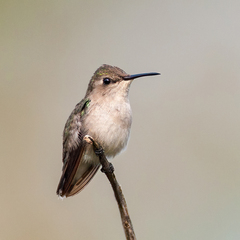
The bee hummingbird, zunzuncito or Helena hummingbird (Mellisuga helenae) is a species of hummingbird, native to the island of Cuba in the Caribbean. It is the smallest known bird. The bee hummingbird feeds on flower nectar and insects.

The bee hummingbird is the smallest living bird. Females weigh 2.6 g (0.092 oz) and are 6.1 cm (2+3⁄8 in) long, and are slightly larger than males, which have an average weight of 1.95 g (0.069 oz) and length of 5.5 cm (2+1⁄8 in). Like all hummingbirds, it is a swift, strong flier.

The male has a green pileum and bright red throat, an iridescent scarlet gorget (when exposed to sunlight) with elongated lateral plumes, bluish upper parts, and the rest of the underparts are mostly greyish white. Compared to other small hummingbirds, which often have a slender appearance, the bee hummingbird looks rounded and plump.

Female bee hummingbirds are bluish green with a pale gray underside. The tips of their tail feathers have white spots. During the mating season, males have a reddish to pink head, chin, and throat. The female lays only two eggs at a time, each about the size of a coffee bean.

The bee hummingbird's feathers have iridescent colors... Wikipedia →

Sounds

Call0:07

Cuba · 2022

© Matt Slaymaker · XC709685 · CC BY-NC-SA 4.0

Song0:15

Cuba · 2012

© William Adsett · XC105248 · CC BY-NC-ND 2.5

Call0:37

Cuba · 2015

© Hans Matheve · XC256743 · CC BY-NC-ND 4.0

Global Distribution

Parks Where Found

# Park Country Daily sighting probability
1 Ciénaga de Zapata 🇨🇺 Cuba
~50%

More parks will be added in future updates.

Before you go

What are the chances of seeing a Bee Hummingbird in Ciénaga de Zapata?

Likely

About 50% of wildlife watchers report a Bee Hummingbird sighting in Ciénaga de Zapata on a given day, based on 879 verified sightings from GBIF citizen-science data from 2019 to 2026. It is the 15th most-seen of the 177 birds we can rate there. Over three days the chance rises to about 90%, and over a week to over 90%, if each day is a fresh chance.

When is the best time to see a Bee Hummingbird in Ciénaga de Zapata?

March and May

In those months about 60% of wildlife watchers report a Bee Hummingbird in Ciénaga de Zapata on a given day, against about 40% in April, October and December–January, the lowest months. September has too few records to rate.

What time of day is best to see a Bee Hummingbird?

Between 3 and 6 pm

Across all the parks we cover, that three-hour window holds the most Bee Hummingbird sightings with a recorded time, and about 9 in 10 of them come between 6 am and 6 pm: it is a daytime animal.

Where else can you see a Bee Hummingbird?

Only Ciénaga de Zapata, in our data

Ciénaga de Zapata is the only park on Wallace's Line with enough records to rate Bee Hummingbird sightings: about 50% of wildlife watchers there report one on a given day.

Where does the Bee Hummingbird sighting chance come from?

GBIF citizen-science records

It is estimated from how often the Bee Hummingbird is recorded against all the birds logged in Ciénaga de Zapata (879 verified sightings from 2019 to 2026), calibrated against known sighting rates. Figures are rounded to the nearest 10% because citizen-science data supports honest approximations, not decimals, and months with records from fewer than five people show "—". How it works.

← Back to Ciénaga de Zapata