Cuban Emerald

Cuban Emerald

Riccordia ricordii

Silhouette: Ferran Sayol · PhyloPic

LCLeast ConcernNTVUENCR
Daily sighting probability ~70% · Very likely
at Ciénaga de Zapata

In 3 days >90%

1,368 Verified sightings at Ciénaga de Zapata From 2019 to 2026
1,368 In 1 park
May Best month
☀️ Diurnal When it's spotted

About the Cuban Emerald

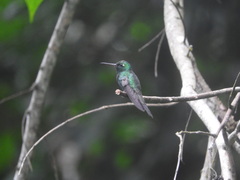
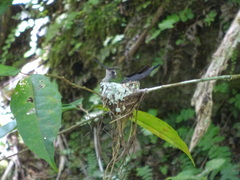
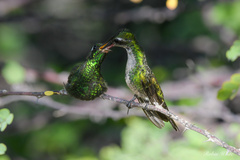
The Cuban emerald (Riccordia ricordii) is a species of hummingbird in the "emeralds", tribe Trochilini of subfamily Trochilinae. It is found in the Bahamas and Cuba. The Cuban emerald was formerly placed in the genus Chlorostilbon. Based on a molecular phylogenetic study published in 2014 and a 2017 publication, the North American Classification Committee of the American Ornithological Society, the International Ornithological Committee (IOC), and the Clements taxonomy moved it to the resurrected genus Riccordia. However, as of 2020 BirdLife International's Handbook of the Birds of the World (HBW) retained it in Chlorostilbon.

The Cuban emerald is monotypic. However, the extinct Brace's emerald (R. bracei) was at one time treated as a subspecies of it. Male Cuban emeralds are 10.5 to 11.5 cm (4.1 to 4.5 in) long and females 9.5 to 10.5 cm (3.7 to 4.1 in). The species weighs between 2.5 and 5 g (0.088 and 0.18 oz). Males have a short, slightly decurved, black-tipped bill whose mandible is dull black and the maxilla red. It has a small whitish spot behind the eye. Its upperparts are dark shining green with a bronze tinge; the crown is darker... Wikipedia →

Sounds

Call0:06

Cuba · 2025

© FREDERIC Lionel · XC996476 · CC BY-NC-SA 4.0

Call0:07

Cuba · 2010

© Jon King · XC66827 · CC BY-NC-ND 2.5

Global Distribution

Parks Where Found

# Park Country Daily sighting probability
1 Ciénaga de Zapata 🇨🇺 Cuba
~70%

More parks will be added in future updates.

Cities Where Found

# City Country Daily sighting probability
1 Havana 🇨🇺 Cuba
~60%

Before you go

What are the chances of seeing a Cuban Emerald in Ciénaga de Zapata?

Very likely

About 70% of wildlife watchers report a Cuban Emerald sighting in Ciénaga de Zapata on a given day, based on 1,368 verified sightings from GBIF citizen-science data from 2019 to 2026. It is the 2nd most-seen of the 177 birds we can rate there. Over three days the chance rises to over 90%, if each day is a fresh chance.

When is the best time to see a Cuban Emerald in Ciénaga de Zapata?

May

In that month about 90% of wildlife watchers report a Cuban Emerald in Ciénaga de Zapata on a given day, against about 50% in June, the lowest month. That is one of Ciénaga de Zapata's wettest months, with about 130 mm of rain against 15 mm in February. September has too few records to rate.

What time of day is best to see a Cuban Emerald?

Between 2 and 5 pm

Across all the parks we cover, that three-hour window holds the most Cuban Emerald sightings with a recorded time, and about 9 in 10 of them come between 6 am and 6 pm: it is a daytime animal.

Where else can you see a Cuban Emerald?

Only Ciénaga de Zapata, in our data

Ciénaga de Zapata is the only park on Wallace's Line with enough records to rate Cuban Emerald sightings: about 70% of wildlife watchers there report one on a given day.

Where does the Cuban Emerald sighting chance come from?

GBIF citizen-science records

It is estimated from how often the Cuban Emerald is recorded against all the birds logged in Ciénaga de Zapata (1,368 verified sightings from 2019 to 2026), calibrated against known sighting rates. Figures are rounded to the nearest 10% because citizen-science data supports honest approximations, not decimals, and months with records from fewer than five people show "—". How it works.

← Back to Ciénaga de Zapata