Cuban Black-Hawk

Cuban Black-Hawk

Buteogallus gundlachii

Silhouette: Sheatherius · PhyloPic

LCNTNear ThreatenedVUENCR Endemic
Daily sighting probability ~40% · Likely
at Ciénaga de Zapata

In 3 days ~80% in a week >90%

661 Verified sightings at Ciénaga de Zapata From 2019 to 2026
661 In 1 park
March Best month
☀️ Diurnal When it's spotted

About the Cuban Black-Hawk

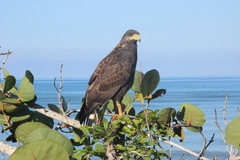
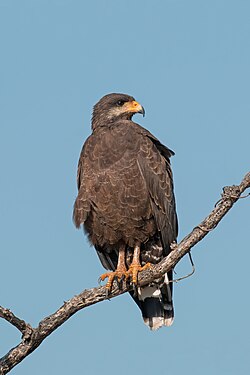
The Cuban black hawk (Buteogallus gundlachii) is a bird of prey in the family Accipitridae. It is endemic to Cuba and several outlying cays. German ornithologist Jean Cabanis described the Cuban black hawk in 1855. It was considered by most authorities to be a subspecies of the Mangrove Black Hawk (Buteogallus anthracinus), although aspects of its behavior were little studied. However, in 2007, the American Ornithologists' Union classified it as a separate species based on differing vocalizations and plumage patterns.

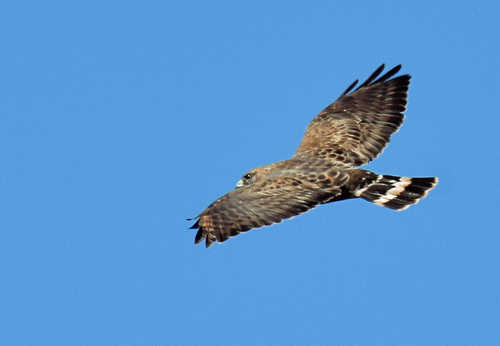
It is one of eight species in the New World genus Buteogallus. The species has an average body length of 53 cm (21 in). The plumage is mainly dark brown verging on black. A lighter greyish or whitish patch may be present on the face between the bill and the eye. White patches at the base of the primary flight feathers are visible in flight. The tail is striped with wide black and white bands. The legs are yellow and the bill is yellow tipped in black. Generally, females tend to be slightly larger in size than males.

The Cuban black hawk is endemic to Cuba, where it is found primarily in coastal and mangrove... Wikipedia →

Sounds

Call0:27

Cuba · 2023

© Bobby Wilcox · XC790283 · CC BY-NC-SA 4.0

Call0:17

Cuba · 2014

© Mark Field · XC202043 · CC BY-NC-SA 4.0

Call1:01

Cuba · 2011

© Laura Gooch · XC72476 · CC BY-NC-ND 2.5

Global Distribution

Parks Where Found

# Park Country Daily sighting probability
1 Ciénaga de Zapata 🇨🇺 Cuba
~40%

More parks will be added in future updates.

Before you go

What are the chances of seeing a Cuban Black-Hawk in Ciénaga de Zapata?

Likely

About 40% of wildlife watchers report a Cuban Black-Hawk sighting in Ciénaga de Zapata on a given day, based on 661 verified sightings from GBIF citizen-science data from 2019 to 2026. It is the 23rd most-seen of the 177 birds we can rate there. Over three days the chance rises to about 80%, and over a week to over 90%, if each day is a fresh chance.

When is the best time to see a Cuban Black-Hawk in Ciénaga de Zapata?

February–March, July and October

In those months about 50% of wildlife watchers report a Cuban Black-Hawk in Ciénaga de Zapata on a given day, against about 30% in April, June, August and December, the lowest months. September has too few records to rate.

What time of day is best to see a Cuban Black-Hawk?

Between 9 am and noon

Across all the parks we cover, that three-hour window holds the most Cuban Black-Hawk sightings with a recorded time, and about 9 in 10 of them come between 6 am and 6 pm: it is a daytime animal.

Where else can you see a Cuban Black-Hawk?

Only Ciénaga de Zapata, in our data

Ciénaga de Zapata is the only park on Wallace's Line with enough records to rate Cuban Black-Hawk sightings: about 40% of wildlife watchers there report one on a given day.

Where does the Cuban Black-Hawk sighting chance come from?

GBIF citizen-science records

It is estimated from how often the Cuban Black-Hawk is recorded against all the birds logged in Ciénaga de Zapata (661 verified sightings from 2019 to 2026), calibrated against known sighting rates. Figures are rounded to the nearest 10% because citizen-science data supports honest approximations, not decimals, and months with records from fewer than five people show "—". How it works.

← Back to Ciénaga de Zapata