Cuban Trogon

Cuban Trogon

Priotelus temnurus

Silhouette: Keith Murdock (photo), John E. McCormack, Michael G. Harvey, Brant C. Faircloth, Nicholas G. Crawford, Travis C. Glenn, Robb T. Brumfield & T. Michael Keesey · PhyloPic

LCLeast ConcernNTVUENCR Endemic
Daily sighting probability ~20% · Possible
at Ciénaga de Zapata

In 3 days ~50% in a week ~80%

350 Verified sightings at Ciénaga de Zapata From 2019 to 2026
350 In 1 park
May Best month
☀️ Diurnal When it's spotted

About the Cuban Trogon

The Cuban trogon or tocororo (Priotelus temnurus) is a species of bird in the family Trogonidae. It is endemic to Cuba, where it is also the national bird. The Cuban trogon shares its genus with the Hispaniolan trogon (P. roseigaster).

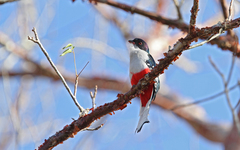
In Cuban Spanish, the bird is known as the tocororo, derived from its onomatopoeic call of "toco-toco-tocoro-tocoro". It is the national bird of Cuba. is 23 to 28 cm (9.1 to 11 in) long and weighs 47 to 75 g (1.7 to 2.6 oz). Its plumage colors match those of Cuba's flag, and are the same for both sexes. The two subspecies also differ only slightly. Their beak is reddish pink with a dark culmen. Adults have a blackish face with reddish eyes, a dark metallic blue crown and nape, and a metallic green back and rump. Their cheeks, chin, and throat are white becoming clear gray on the breast and upper belly. Their lower belly and undertail coverts are red. Their tail is graduated, with the innermost feathers forming a point. The three innermost pairs of tail feathers are glossy blue-black with some bronzy highlights. The three outer pairs... Wikipedia →

Sounds

Uncertain1:03

Cuba · 2025

© FREDERIC Lionel · XC997853 · CC BY-NC-SA 4.0

Song1:06

Cuba · 2015

© Hans Matheve · XC256810 · CC BY-NC-ND 4.0

Call0:38

Cuba · 2011

© Laura Gooch · XC72532 · CC BY-NC-ND 2.5

Global Distribution

Parks Where Found

# Park Country Daily sighting probability
1 Ciénaga de Zapata 🇨🇺 Cuba
~20%

More parks will be added in future updates.

Cities Where Found

# City Country Daily sighting probability
1 Havana 🇨🇺 Cuba
<5%

Zoos & Centres Where Found

# Zoo / Centre Country
1 Oasi Naturalistica di Sant'Alessio 🇮🇹 Italy In captivity

Before you go

What are the chances of seeing a Cuban Trogon in Ciénaga de Zapata?

Possible

About 20% of wildlife watchers report a Cuban Trogon sighting in Ciénaga de Zapata on a given day, based on 350 verified sightings from GBIF citizen-science data from 2019 to 2026. It is the 76th most-seen of the 177 birds we can rate there. Over three days the chance rises to about 50%, and over a week to about 80%, if each day is a fresh chance.

When is the best time to see a Cuban Trogon in Ciénaga de Zapata?

May

In that month about 50% of wildlife watchers report a Cuban Trogon in Ciénaga de Zapata on a given day, against about 10% in December and January, the lowest months. That is one of Ciénaga de Zapata's wettest months, with about 130 mm of rain against 15 mm in February. September has too few records to rate.

What time of day is best to see a Cuban Trogon?

Between 8 and 11 am

Across all the parks we cover, that three-hour window holds the most Cuban Trogon sightings with a recorded time, and about 9 in 10 of them come between 6 am and 6 pm: it is a daytime animal.

Where else can you see a Cuban Trogon?

Only Ciénaga de Zapata, in our data

Ciénaga de Zapata is the only park on Wallace's Line with enough records to rate Cuban Trogon sightings: about 20% of wildlife watchers there report one on a given day.

Where does the Cuban Trogon sighting chance come from?

GBIF citizen-science records

It is estimated from how often the Cuban Trogon is recorded against all the birds logged in Ciénaga de Zapata (350 verified sightings from 2019 to 2026), calibrated against known sighting rates. Figures are rounded to the nearest 10% because citizen-science data supports honest approximations, not decimals, and months with records from fewer than five people show "—". How it works.

← Back to Ciénaga de Zapata