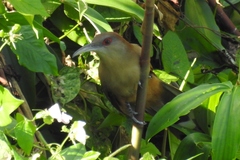
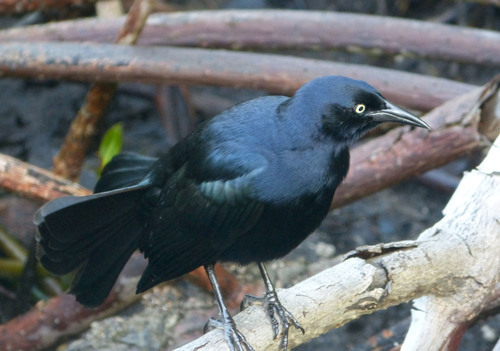
Great Lizard-Cuckoo

Great Lizard-Cuckoo

Saurothera merlini

Silhouette: Nicolas Huet le Jeune and Jean-Gabriel Prêtre (vectorized by T. Michael Keesey) · PhyloPic

Daily sighting probability ~30% · Possible
at Ciénaga de Zapata

In 3 days ~60% in a week ~90%

441 Verified sightings at Ciénaga de Zapata From 2019 to 2026
441 In 1 park
July Best month
☀️ Diurnal When it's spotted

About the Great Lizard-Cuckoo

The great lizard cuckoo (Coccyzus merlini) is a species of bird in the tribe Phaenicophaeini, subfamily Cuculinae of the cuckoo family Cuculidae. It is found in the Bahamas and Cuba. The great lizard cuckoo and three other lizard cuckoos were for a time considered a single species. Individually they were previously placed in genus Saurothera that was later merged into the current Coccyzus, and they are considered a superspecies. The North American Classification Committee of the American Ornithological Society, the International Ornithological Committee, and the Clements taxonomy assign it these four subspecies:

During part of the 19th century C. m. bahamensis was treated as a separate species, the Bahama lizard cuckoo, and the other three subspecies were collectively known as the Cuban lizard cuckoo. BirdLife International's Handbook of the Birds of the World has reverted to that two-species treatment.

The great lizard cuckoo is the largest species in genus Coccyzus. It is 42 to 54 cm (17 to 21 in... Wikipedia →
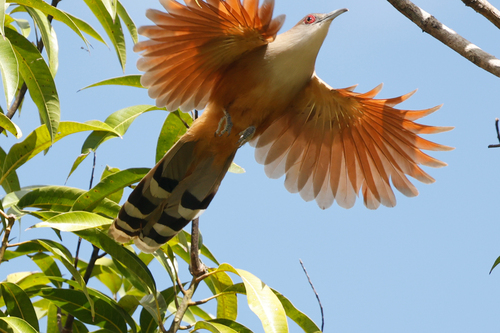
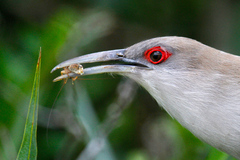
Sounds

Recording0:16

Cuba · 2018

© mjfeldman · iNaturalist · CC BY-NC 4.0

Global Distribution

Parks Where Found

# Park Country Daily sighting probability
1 Ciénaga de Zapata 🇨🇺 Cuba
~30%

More parks will be added in future updates.

Cities Where Found

# City Country Daily sighting probability
1 Havana 🇨🇺 Cuba
<5%

Before you go

What are the chances of seeing a Great Lizard-Cuckoo in Ciénaga de Zapata?

Possible

About 30% of wildlife watchers report a Great Lizard-Cuckoo sighting in Ciénaga de Zapata on a given day, based on 441 verified sightings from GBIF citizen-science data from 2019 to 2026. It is the 55th most-seen of the 177 birds we can rate there. Over three days the chance rises to about 60%, and over a week to about 90%, if each day is a fresh chance.

When is the best time to see a Great Lizard-Cuckoo in Ciénaga de Zapata?

February, May and July

In those months about 40% of wildlife watchers report a Great Lizard-Cuckoo in Ciénaga de Zapata on a given day, against about 20% in October to December, the lowest months. September has too few records to rate.

What time of day is best to see a Great Lizard-Cuckoo?

Between 8 and 11 am

Across all the parks we cover, that three-hour window holds the most Great Lizard-Cuckoo sightings with a recorded time, and about 9 in 10 of them come between 6 am and 6 pm: it is a daytime animal.

Where else can you see a Great Lizard-Cuckoo?

Only Ciénaga de Zapata, in our data

Ciénaga de Zapata is the only park on Wallace's Line with enough records to rate Great Lizard-Cuckoo sightings: about 30% of wildlife watchers there report one on a given day.

Where does the Great Lizard-Cuckoo sighting chance come from?

GBIF citizen-science records

It is estimated from how often the Great Lizard-Cuckoo is recorded against all the birds logged in Ciénaga de Zapata (441 verified sightings from 2019 to 2026), calibrated against known sighting rates. Figures are rounded to the nearest 10% because citizen-science data supports honest approximations, not decimals, and months with records from fewer than five people show "—". How it works.

← Back to Ciénaga de Zapata