About the African Weaver Ant
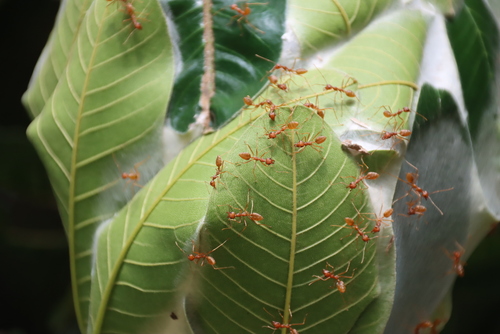
Oecophylla longinoda (common name weaver ant) is a species of arboreal ant found in the forested regions of tropical Africa. They are one of only two extant species of the genus, the other being Oecophylla smaragdina. They make nests in trees made of leaves stitched together using the silk produced by their larvae.
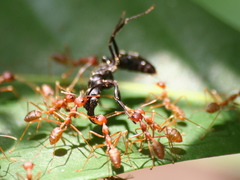
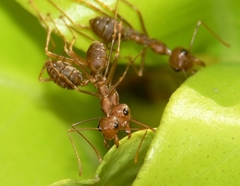
The worker is a fairly large ant with a length of 6 mm (0.24 in). Their antennae have 12 segments, the first segment exceeding in length the second and third combined. The clypeus, at the front of the head, is large, convex, and hangs over the outer edge of the mouthparts. The large mandibles have long, triangular teeth, which cross over one another when the ant is at rest. This ant ranges in colour from orangeish-brown to dark brown; the thorax is clad in fine pubescence, while the abdomen is covered with short, erect hairs. The tip of the abdomen has glands that produce pheromones. The feet have suction pads, which enable these ants to cling to surfaces with a firm grip.
This weaver ant is widely distributed across the rainforests of sub-Saharan Africa. It is found high in the canopy and one colony can dominate the crown... Wikipedia →