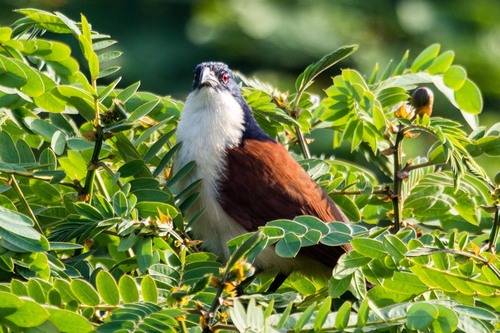
Blue-headed Coucal

Blue-headed Coucal

Centropus monachus

Silhouette: Nicolas Huet le Jeune and Jean-Gabriel Prêtre (vectorized by T. Michael Keesey) · PhyloPic

LCLeast ConcernNTVUENCR
Daily sighting probability <5% · Rare
at Accra

In 3 days ~10%

8 Verified sightings at Accra
786 In all 10 parks From 2019 to 2026
July Best month
☀️ Diurnal When it's spotted

About the Blue-headed Coucal

The blue-headed coucal (Centropus monachus) is a species of cuckoo in the family Cuculidae. It is native to tropical central Africa where its typical habitat is swamps, river banks, forest edges and generally wet locations. It is a common bird with a wide range, and the International Union for Conservation of Nature has rated its conservation status as being of "least concern".

The blue-headed coucal is a medium-sized species growing to 45 to 52 cm (18 to 20 in) in length. The sexes are similar, the adult having the head, sides of neck and back black, glossed with blue, the lower back and rump black, the wings predominantly deep chestnut and the tail black, glossed with green or bronze. The underparts are white or pale buff. The eyes are dark red, the beak black and the legs and feet greyish-black. The juvenile is similar to the adult but the black areas are dull rather than glossy; the head is streaked with rufous-buff, the wings are dark chestnut heavily barred with dark brown, and the back and tail are barred with buff. The throat and breast feathers are spotted with black.

The blue-headed coucal occurs in tropical central Africa at... Wikipedia →
Sounds

Uncertain0:16

Gabon · 2021

© BurBenj · XC669328 · CC BY-NC-SA 4.0

Song0:38

Ethiopia · 2015

© Peter Boesman · XC300086 · CC BY-NC-ND 4.0

Call0:10

Ethiopia · 2014

© Andrew Spencer · XC278368 · CC BY-NC-ND 4.0

Global Distribution

Parks Where Found

# Park Country Daily sighting probability
1 Semuliki National Park 🇺🇬 Uganda
~30%
2 Akagera National Park 🇷🇼 Rwanda
~10%
3 Aberdare National Park 🇰🇪 Kenya
~10%
4 Kibale National Park 🇺🇬 Uganda
~10%
5 Murchison Falls National Park 🇺🇬 Uganda
~10%
6 Bwindi Impenetrable National Park 🇺🇬 Uganda
<5%
7 Nyungwe National Park 🇷🇼 Rwanda
<5%
8 Kidepo Valley National Park 🇺🇬 Uganda
<5%
9 Lake Mburo National Park 🇺🇬 Uganda
<5%
10 Queen Elizabeth National Park 🇺🇬 Uganda
<5%

Cities Where Found

# City Country Daily sighting probability
1 Yaoundé 🇨🇲 Cameroon
~30%
2 Brazzaville 🇨🇬 Republic of the Congo
~10%
3 Kigali 🇷🇼 Rwanda
~10%
4 Abuja 🇳🇬 Nigeria
~10%
5 Kumasi 🇬🇭 Ghana
~10%
6 Kampala 🇺🇬 Uganda
<5%
7 Accra 🇬🇭 Ghana
<5%

Before you go

What are the chances of seeing a Blue-headed Coucal in Accra?

Rare

Under 5% of wildlife watchers report a Blue-headed Coucal sighting in Accra on a given day, based on 8 verified sightings from GBIF citizen-science data. It is the 135th most-seen of the 162 birds we can rate there. Over three days the chance rises to about 10%, if each day is a fresh chance.

When is the best time to see a Blue-headed Coucal in Accra?

July

In that month about 10% of wildlife watchers report a Blue-headed Coucal in Accra on a given day, against under 5% in August to June, the lowest months.

What time of day is best to see a Blue-headed Coucal?

Between 7 and 10 am

Across all the parks we cover, that three-hour window holds the most Blue-headed Coucal sightings with a recorded time, and about 9 in 10 of them come between 6 am and 6 pm: it is a daytime animal.

Is Accra the best place to see a Blue-headed Coucal?

7th of 7

Of the 7 cities where we can rate Blue-headed Coucal sightings, Accra ranks 7th at under 5%. The best odds are in Yaoundé (Cameroon, about 30%), Brazzaville (Republic of the Congo, about 10%) and Kigali (Rwanda, about 10%).

Where does the Blue-headed Coucal sighting chance come from?

GBIF citizen-science records

It is estimated from how often the Blue-headed Coucal is recorded against all the birds logged in Accra (8 verified sightings), calibrated against known sighting rates. Figures are rounded to the nearest 10% because citizen-science data supports honest approximations, not decimals, and months with records from fewer than five people show "—". How it works.

← Back to Accra