Orange-cheeked Waxbill

Orange-cheeked Waxbill

Estrilda melpoda

Silhouette: Ferran Sayol · PhyloPic

LCLeast ConcernNTVUENCR
Daily sighting probability <5% · Rare
at Accra

In 3 days ~10% in a week ~20%

13 Verified sightings at Accra
238 In all 3 parks From 2019 to 2026
April Best month
☀️ Diurnal When it's spotted

About the Orange-cheeked Waxbill

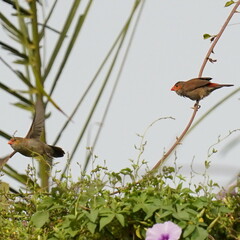
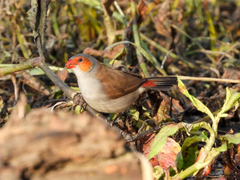
The orange-cheeked waxbill (Estrilda melpoda) is a common species of estrildid finch native to western and central Africa, with an estimated global extent of occurrence of 3,600,000 km2. The orange-cheeked waxbill lives in small family parties or flocks of thirty of more individuals. Their high-pitched peeps are the best clue of their presence. Like most estridids, they are very acrobatic in their movements on twigs and grass stems, "climbing" up and down verticals and hanging upside down while feeding. Males usually have brighter orange patches on the abdomen.

They feed on tiny grass seeds, which they collect from the ground or, more often, directly from grass panicles. They hang on the stems and harvest the ripe or green seeds, sometimes while hanging upside down. Small insects such as termites, aphids, and gnats are taken during the breeding season.

This species prefers to nest close to or directly on the ground in tangled clumps of tall grass. They will collect the surrounding grass stems together, especially old seed heads (panicles), helping to camouflage the structure. Fine white feathers line the interior where three to six tiny white... Wikipedia →

Sounds

Uncertain0:16

Ghana · 2001

© András Schmidt · XC747962 · CC BY-NC-SA 4.0

Call0:54

Ghana · 2022

© Peter Boesman · XC719127 · CC BY-NC-ND 4.0

Flock chattering0:24

Ghana · 2016

© Rolf A. de By · XC301477 · CC BY-NC-SA 3.0

Global Distribution

Parks Where Found

# Park Country Daily sighting probability
1 Semuliki National Park 🇺🇬 Uganda
~30%
2 Niokolo-Koba National Park 🇸🇳 Senegal
~30%
3 Odzala-Kokoua National Park 🇨🇬 Republic of the Congo
~20%

Cities Where Found

# City Country Daily sighting probability
1 Yaoundé 🇨🇲 Cameroon
~10%
2 Brazzaville 🇨🇬 Republic of the Congo
~10%
3 Taichung 🇹🇼 Taiwan
~10%
4 Accra 🇬🇭 Ghana
<5%
5 Serrekunda 🇬🇲 Gambia
<5%
6 Singapore 🇸🇬 Singapore
<5%
7 Doha 🇶🇦 Qatar
<5%
8 Taipei 🇹🇼 Taiwan
<5%
9 Kaohsiung 🇹🇼 Taiwan
<5%
10 Los Angeles 🇺🇸 United States
<5%

Zoos & Centres Where Found

# Zoo / Centre Country
1 Zoo Miami 🇺🇸 United States In captivity
2 Bloedel Conservatory 🇨🇦 Canada In captivity

Before you go

What are the chances of seeing an Orange-cheeked Waxbill in Accra?

Rare

Under 5% of wildlife watchers report an Orange-cheeked Waxbill sighting in Accra on a given day, based on 13 verified sightings from GBIF citizen-science data. It is the 117th most-seen of the 162 birds we can rate there. Over three days the chance rises to about 10%, and over a week to about 20%, if each day is a fresh chance.

When is the best time to see an Orange-cheeked Waxbill in Accra?

January, April and September

In those months about 10% of wildlife watchers report an Orange-cheeked Waxbill in Accra on a given day, against under 5% in February–March, May–August and October–December, the lowest months.

What time of day is best to see an Orange-cheeked Waxbill?

Between 7 and 10 am

Across all the parks we cover, that three-hour window holds the most Orange-cheeked Waxbill sightings with a recorded time, and about 9 in 10 of them come between 6 am and 6 pm: it is a daytime animal.

Is Accra the best place to see an Orange-cheeked Waxbill?

4th of 11

Of the 11 cities where we can rate Orange-cheeked Waxbill sightings, Accra ranks 4th at under 5%. The best odds are in Yaoundé (Cameroon, about 10%), Brazzaville (Republic of the Congo, about 10%) and Taichung (Taiwan, about 10%).

Which relatives of the Orange-cheeked Waxbill live in Accra?

Same family: Estrildidae

The closest relatives of the Orange-cheeked Waxbill that you can see in Accra (family Estrildidae, Waxbills and Allies) are Bronze Mannikin (about 30%) and Bar-breasted Firefinch (about 10%), with each one's daily chance of a sighting.

Where does the Orange-cheeked Waxbill sighting chance come from?

GBIF citizen-science records

It is estimated from how often the Orange-cheeked Waxbill is recorded against all the birds logged in Accra (13 verified sightings), calibrated against known sighting rates. Figures are rounded to the nearest 10% because citizen-science data supports honest approximations, not decimals, and months with records from fewer than five people show "—". How it works.

← Back to Accra