Abyssinian Catbird

Abyssinian Catbird

Parophasma galinieri

Silhouette: PhyloPic

Daily sighting probability ~10% · With luck
at Addis Ababa

In 3 days ~20% in a week ~30%

20 Verified sightings at Addis Ababa
61 In 1 park From 2019 to 2026
September Best month
☀️ Diurnal When it's spotted

About the Abyssinian Catbird

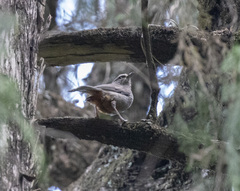
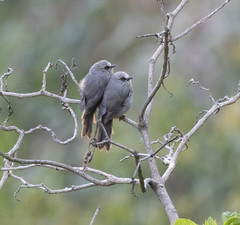
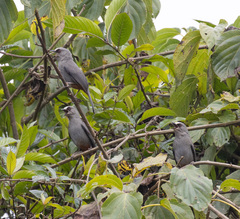
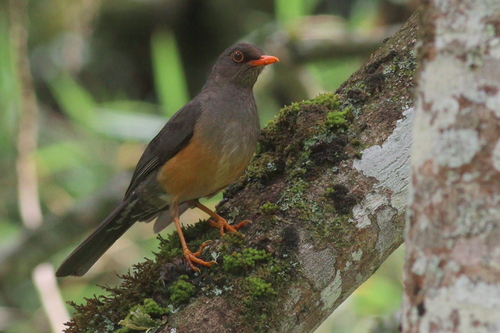
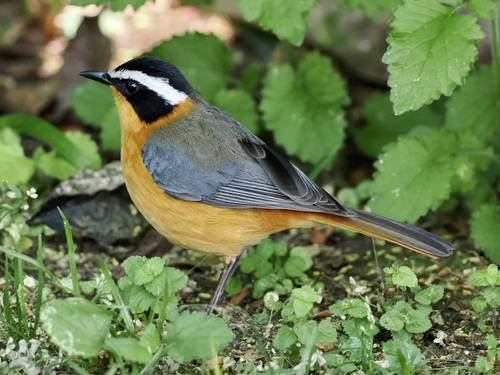
The Abyssinian catbird (Sylvia galinieri), also known as the juniper babbler, is a small passerine in the family Sylviidae, endemic to the highland forests and scrub of Ethiopia. Despite its name, it is unrelated to other birds called "catbirds." It is mostly grey, with black lores, a whitish forehead, and a chestnut vent.

The Abyssinian catbird is a small-sized babbler. Its body is round with relatively short wings and legs. The bird's belly is white, but its upper parts are a lighter shade of grey that gradually fades to a darker shade moving to the backside of the bird. The head of the bird is a light shade of grey with dark highlights surrounding the eyes. The eyes themselves have a scarlet iris surrounding dark brown pupils. The beak is short pointed and black. Its wings are the darkest parts of its body having parallel bars of black along its length with the rest of the wing being grey. Its underside from its legs to its tail is a distinct orange that gives way to a tail that is about half the length of the bird itself. Abyssinian catbirds measure around 19 cm (7.5 in) in length.

The bird was formerly the sole member of the genus Parophasma, and its taxonomy... Wikipedia →

Global Distribution

Parks Where Found

# Park Country Daily sighting probability
1 Bale Mountains National Park 🇪🇹 Ethiopia
~20%

More parks will be added in future updates.

Cities Where Found

# City Country Daily sighting probability
1 Addis Ababa 🇪🇹 Ethiopia
~10%

Before you go

What are the chances of seeing an Abyssinian Catbird in Addis Ababa?

With luck

About 10% of wildlife watchers report an Abyssinian Catbird sighting in Addis Ababa on a given day, based on 20 verified sightings from GBIF citizen-science data. It is the 57th most-seen of the 109 birds we can rate there. Over three days the chance rises to about 20%, and over a week to about 30%, if each day is a fresh chance.

When is the best time to see an Abyssinian Catbird in Addis Ababa?

September

In that month about 20% of wildlife watchers report an Abyssinian Catbird in Addis Ababa on a given day, against under 5% in January–June and October–November, the lowest months. That is one of Addis Ababa's wettest months, with about 150 mm of rain against 10 mm in January.

What time of day is best to see an Abyssinian Catbird?

Between 6 and 9 am

Across all the parks we cover, that three-hour window holds the most Abyssinian Catbird sightings with a recorded time, and about 9 in 10 of them come between 6 am and 6 pm: it is a daytime animal.

Where else can you see an Abyssinian Catbird?

Only Addis Ababa, in our data

Addis Ababa is the only city on Wallace's Line with enough records to rate Abyssinian Catbird sightings: about 10% of wildlife watchers there report one on a given day.

Where does the Abyssinian Catbird sighting chance come from?

GBIF citizen-science records

It is estimated from how often the Abyssinian Catbird is recorded against all the birds logged in Addis Ababa (20 verified sightings), calibrated against known sighting rates. Figures are rounded to the nearest 10% because citizen-science data supports honest approximations, not decimals, and months with records from fewer than five people show "—". How it works.

← Back to Addis Ababa