About the Eastern Subalpine Warbler
The eastern subalpine warbler (Curruca cantillans) is a small Sylviidae warbler which breeds in the southernmost areas of Europe. It was first described by the German naturalist Peter Simon Pallas in 1764 and given the binomial name Motacilla cantillans. The specific cantillans is Latin for "warbling" from canere, "to sing".
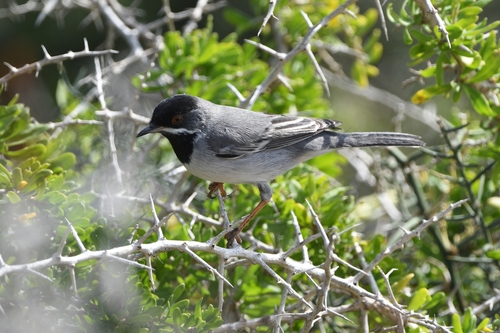
Like most Curruca species, it has distinct male and female plumages. The adult male has a grey back and head, brick-red underparts, and white malar streaks ("moustaches"). The female is mainly brown above, with a greyer head, and whitish below with a pink flush. The subalpine warbler's song is fast and rattling, and is similar to the lesser whitethroat.
This bird seems to be related to the Sardinian warbler-Menetries' warbler superspecies. They all have white malar areas, the heads being dark above in adult males, and naked eye-rings. These three species are related to a superspecies consisting of Rüppell's warbler and the Cyprus warbler, which also share the white malar area with blackish above (Shirihai et al. 2001, Jønsson & Fjeldså 2006 ).
The subalpine warbler is divided into two distinct subspecies groups, which may possibly be sufficiently diverged to qualify as two separate species (Shirihai et al. 2001). The two groups have differing male plumages, distinctive calls, and are allopatric; on this particular issue, further study is needed. In May 2020, the IOC world bird list recognised the split of western and eastern subalpine warblers into two distinct species.
Moltoni's warbler was formerly considered conspecific. The eastern subalpine warbler differs from the western subalpine warbler by its deeper blue-grey upperparts, a blackish mask on the lores and ear-coverts, brick reddish-brown coloration confined to the throat and breast and sharply demarcated from a largely white belly, paler flanks and a wider white submoustachial stripe.
This is a bird of dry open country, often on hill slopes, with bushes for nesting. The nest is built in low shrub or gorse, and 3–5 eggs are laid. Like most "warblers", it is insectivorous, but will also take berries. Wikipedia →