Egyptian Rousette

Egyptian Rousette

Rousettus aegyptiacus

Silhouette: Steven Traver · PhyloPic

LCLeast ConcernNTVUENCR
Daily sighting probability ~50% · Likely
at Antalya

In 3 days ~90% in a week >90%

21 Verified sightings at Antalya
12 In 1 park From 2019 to 2026
October Best month
☀️🌙 Day & Night When it's spotted

About the Egyptian Rousette

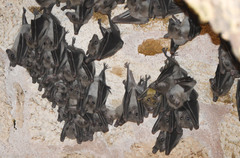
The Egyptian fruit bat or Egyptian rousette (Rousettus aegyptiacus) is a species of megabat that occurs in Africa, the Middle East, the Mediterranean and the Indian subcontinent. It is one of three Rousettus species with an African-Malagasy range, though the only species of its genus found on continental Africa. The common ancestor of the three species colonized the region in the late Pliocene or early Pleistocene. The species is traditionally divided into six subspecies. It is considered a medium-sized megabat, with adults weighing 80–170 g (2.8–6.0 oz) and possessing wingspans of approximately 60 cm (24 in). Individuals are dark brown or grayish brown, with their undersides paler than their backs.

The Egyptian fruit bat is a highly social species, usually living in colonies with thousands of other bats. It, along with other members of the genus Rousettus, are some of the only fruit bats to use echolocation, though a more primitive version than used by bats in other families. It has also developed a socially-complex vocalization system to communicate with conspecifics. The Egyptian fruit bat is a frugivore that consumes a variety of fruits depending on the season and local availability. Because of its consumption of commercially-grown fruits, the Egyptian fruit bat is considered a pest by farmers. It also acts as a pollinator and seed disperser for many species of trees and other plants. Wikipedia →

Sounds

Recording0:13

Egypt · 2023

© Mickey · iNaturalist · CC BY-NC 4.0

Recording0:10

Israel · 2025

© aargon · iNaturalist · CC BY-NC 4.0

Recording0:04

Egypt · 2024

© michel_kilcher · iNaturalist · CC BY-NC 4.0

Global Distribution

Parks Where Found

# Park Country Daily sighting probability
1 Table Mountain National Park 🇿🇦 South Africa
<5%

More parks will be added in future updates.

Cities Where Found

# City Country Daily sighting probability
1 Antalya 🇹🇷 Turkey
~50%
2 Cairo 🇪🇬 Egypt
~30%
3 Tel Aviv 🇮🇱 Israel
~20%

Zoos & Centres Where Found

# Zoo / Centre Country
1 Pairi Daiza 🇧🇪 Belgium In captivity
2 Copenhagen Zoo 🇩🇰 Denmark In captivity
3 Zoo Pilsen 🇨🇿 Czechia In captivity
4 Kaliningrad Zoo 🇷🇺 Russia In captivity
5 Zoobotánico Jerez 🇪🇸 Spain In captivity
6 Toronto Zoo 🇨🇦 Canada In captivity
7 Omaha’s Henry Doorly Zoo and Aquarium 🇺🇸 United States In captivity
8 Cotswold Wildlife Park 🇬🇧 United Kingdom In captivity
9 Parque Zoológico de León - Zooleón 🇲🇽 Mexico In captivity
10 Selwo Aventura 🇪🇸 Spain In captivity
11 Folly Farm Adventure Park and Zoo 🇬🇧 United Kingdom In captivity
12 Yaroslavl Zoo 🇷🇺 Russia In captivity
13 Safari de Peaugres Circuit Auto 🇫🇷 France In captivity
14 Kyiv Zoo 🇺🇦 Ukraine In captivity
15 Terra Natura Benidorm 🇪🇸 Spain In captivity
16 Oregon Zoo 🇺🇸 United States In captivity
17 Zoo de La Flèche 🇫🇷 France In captivity
18 Blank Park Zoo 🇺🇸 United States In captivity
19 La Palmyre Zoo 🇫🇷 France In captivity
20 Kharkiv Zoo 🇺🇦 Ukraine In captivity
21 Krakow Zoo 🇵🇱 Poland In captivity
22 Faunia 🇪🇸 Spain In captivity
23 Lincoln Park Zoo 🇺🇸 United States In captivity
24 Reserva Zoológica Oasys MiniHollywood 🇪🇸 Spain In captivity
25 Tennōji Zoo 🇯🇵 Japan In captivity
26 Paphos Zoo 🇨🇾 Cyprus In captivity
27 Oradea Zoological Garden 🇷🇴 Romania In captivity
28 Kazan Zoo & Botanical Garden 🇷🇺 Russia In captivity
29 Elmwood Park Zoo 🇺🇸 United States In captivity
30 Living Treasures "Wild" Animal Park 🇺🇸 United States In captivity
31 VigoNature 🇪🇸 Spain In captivity
32 Voronezh Zoo 🇷🇺 Russia In captivity
33 Kharkiv Dolphinarium 🇺🇦 Ukraine In captivity
34 Bird Kingdom 🇨🇦 Canada In captivity
35 Mondo Verde, Landgraaf 🇳🇱 Netherlands In captivity

Closest Relatives at Antalya

No species of the same family or order lives in Antalya, so these are its closest relatives here: other mammals.

Before you go

What are the chances of seeing an Egyptian Rousette in Antalya?

Likely

About 50% of wildlife watchers report an Egyptian Rousette sighting in Antalya on a given day, based on 21 verified sightings from GBIF citizen-science data. Over three days the chance rises to about 90%, and over a week to over 90%, if each day is a fresh chance.

When is the best time to see an Egyptian Rousette in Antalya?

June and October

In those months about 70% of wildlife watchers report an Egyptian Rousette in Antalya on a given day, against about 10% in September and December–February, the lowest months. Those are among Antalya's driest months, with about 40 mm of rain a month against 180 mm in January.

What time of day is best to see an Egyptian Rousette?

Between 8 and 11 pm

Across all the parks we cover, that three-hour window holds the most Egyptian Rousette sightings with a recorded time, and about 6 in 10 of them come between 6 am and 6 pm: it is seen both by day and at night.

Is Antalya the best place to see an Egyptian Rousette?

Yes

Of the 3 cities where we can rate Egyptian Rousette sightings, Antalya has the highest daily chance: about 50%. Next come Cairo (Egypt, about 30%) and Tel Aviv (Israel, about 20%).

Where does the Egyptian Rousette sighting chance come from?

GBIF citizen-science records

It is estimated from how often the Egyptian Rousette is recorded against all the mammals logged in Antalya (21 verified sightings), calibrated against known sighting rates. Figures are rounded to the nearest 10% because citizen-science data supports honest approximations, not decimals, and months with records from fewer than five people show "—". How it works.

← Back to Antalya