About the Lesser House Fly
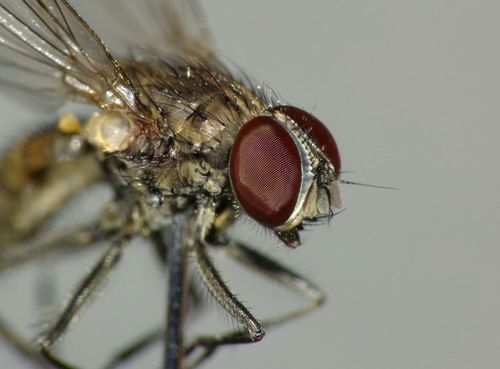
The lesser house fly (Fannia canicularis), commonly known as little house fly, is a species of fly. It is somewhat smaller (3.5–6 mm (0.14–0.24 in)) than the common housefly and is best known for its habit of entering buildings and flying in jagged patterns in the middle of a room. It is slender, and the median vein in the wing is straight. Larvae feed on all manner of decaying organic matter, including carrion. Though similar in appearance and habits, it is no closer in relation to a house fly than any other fly in order Diptera is.
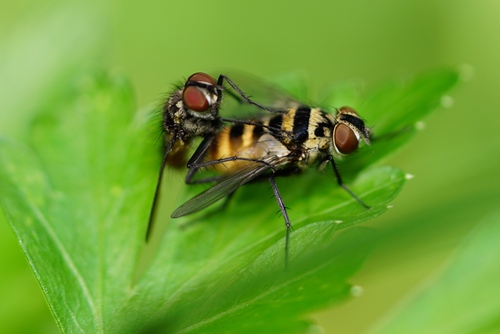
Fannia canicularis is a slim fly reaching a length of from 4 to 6 mm. The white-bordered eyes meet above in the male, a condition described as holoptic. In females, the eyes do not meet. The brown-grey thorax has three black, longitudinal stripes in the males. These are much less distinct in the female. The first two segments of the abdomen are translucently yellow with a dark-brown basal colour. The dark trapezoid marks of the males are hardly recognizable in the females. The halteres are yellowish.
The females lay their eggs in batches of up to 50 and may lay up to 2,000 eggs altogether. The eggs, which are white... Wikipedia →