
New Zealand Dabchick

New Zealand Dabchick

Poliocephalus rufopectus

Silhouette: Tisha Mukherjee · PhyloPic

LCLeast ConcernNTVUENCR Endemic
Daily sighting probability ~10% · With luck
at Auckland

In 3 days ~40% in a week ~70%

674 Verified sightings at Auckland
February Best month
☀️ Diurnal When it's spotted

About the New Zealand Dabchick

The New Zealand grebe (Poliocephalus rufopectus), also known as the New Zealand dabchick or weweia, is a member of the grebe family endemic to New Zealand. Poliocephalus rufopectus is an aquatic diving bird in the grebe order.

Poliocephalus rufopectus (G.R.Gray) was originally described by the English ornithologist George Robert Gray as Podiceps rufopectus G.R.Gray, 1843 (in subgenus Poliocephalus). The type specimen was collected by British botanist and scientific collector Andrew Sinclair in New Zealand. P. rufopectus is one of two species in the genus Poliocephalus, with the other being the hoary-headed grebe (Poliocephalus poliocephalus) which is native to Australia.

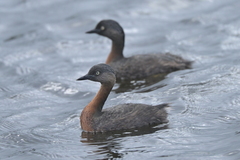
The New Zealand grebe has dark brown plumage, a small black head with fine silver feathers, a black pointed bill and characteristic yellow eyes. It grows to about 29 cm (11 in), and weighs about 250 g (8.8 oz). Non-breeding individuals have a paler plumage and females tend to be a bit lighter, smaller and have a slightly shorter bill than males.

This grebe species inhabits mainly shallow freshwater lakes, ponds and sheltered inlets. Currently it is found... Wikipedia →

Sounds

Alarm call0:05

New Zealand · 2026

© Nathan El · XC1105863 · CC BY-NC-SA 4.0

Global Distribution

Parks Where Found

# Park Country Daily sighting probability

More parks will be added in future updates.

Cities Where Found

# City Country Daily sighting probability
1 Auckland 🇳🇿 New Zealand
~10%

Before you go

What are the chances of seeing a New Zealand Dabchick in Auckland?

With luck

About 10% of wildlife watchers report a New Zealand Dabchick sighting in Auckland on a given day, based on 674 verified sightings from GBIF citizen-science data. It is the 40th most-seen of the 93 birds we can rate there. Over three days the chance rises to about 40%, and over a week to about 70%, if each day is a fresh chance.

When is the best time to see a New Zealand Dabchick in Auckland?

November to February

In those months about 20% of wildlife watchers report a New Zealand Dabchick in Auckland on a given day, against about 10% in March to October, the lowest months.

What time of day is best to see a New Zealand Dabchick?

Between 1 and 4 pm

Across all the parks we cover, that three-hour window holds the most New Zealand Dabchick sightings with a recorded time, and about 9 in 10 of them come between 6 am and 6 pm: it is a daytime animal.

Where else can you see a New Zealand Dabchick?

Only Auckland, in our data

Auckland is the only city on Wallace's Line with enough records to rate New Zealand Dabchick sightings: about 10% of wildlife watchers there report one on a given day.

Where does the New Zealand Dabchick sighting chance come from?

GBIF citizen-science records

It is estimated from how often the New Zealand Dabchick is recorded against all the birds logged in Auckland (674 verified sightings), calibrated against known sighting rates. Figures are rounded to the nearest 10% because citizen-science data supports honest approximations, not decimals, and months with records from fewer than five people show "—". How it works.

← Back to Auckland