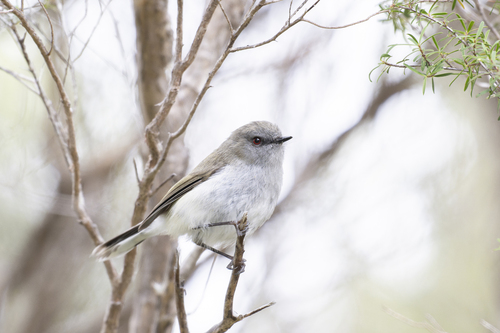
Tūī

Tūī

Prosthemadera novaeseelandiae

Silhouette: Rachael Joakim · PhyloPic

LCLeast ConcernNTVUENCR Endemic
Daily sighting probability ~70% · Very likely
at Auckland

In 3 days >90%

6,127 Verified sightings at Auckland
5,407 In all 6 parks From 2019 to 2026
September Best month
☀️ Diurnal When it's spotted

About the Tūī

The tūī (Prosthemadera novaeseelandiae) is a medium-sized bird native to New Zealand. It is blue, green, and bronze coloured with a distinctive white throat tuft (poi). It is an endemic passerine bird of New Zealand, and the only species in the genus Prosthemadera. It is one of the largest species in the diverse Australasian honeyeater family Meliphagidae, and one of two living species of that family found in New Zealand, the other being the New Zealand bellbird (Anthornis melanura). The tūī has a wide distribution in the archipelago, ranging from the subtropical Kermadec Islands to the sub-Antarctic Auckland Islands, as well as the main islands.

Europeans first encountered the tūī in 1770 at Queen Charlotte Sound on the north coast of New Zealand's South Island during Captain James Cook's first voyage to the Pacific Ocean. Specimens were brought back to England and an engraving of a tūī by the English naturalist Peter Brown, which he called "The New Zeland creeper", was published in 1776. The tūī was seen on all three of Cook's voyages. Cook's account of his second voyage to the Pacific was published in 1777 and included a description and an illustration of the tūī.... Wikipedia →

Sounds

Call0:40

New Zealand · 2026

© Ken George · XC1093636 · CC BY-NC-SA 4.0

Song0:24

New Zealand · 2025

© David Boyle · XC979583 · CC BY-NC-SA 4.0

Song0:59

New Zealand · 2024

© craig wilson · XC915121 · CC BY 4.0

Global Distribution

Parks Where Found

# Park Country Daily sighting probability
1 Egmont National Park 🇳🇿 New Zealand
~90%
2 Rakiura National Park 🇳🇿 New Zealand
~90%
3 Abel Tasman National Park 🇳🇿 New Zealand
~60%
4 Fiordland National Park 🇳🇿 New Zealand
~60%
5 Arthur's Pass National Park 🇳🇿 New Zealand
~10%
6 Aoraki Mount Cook National Park 🇳🇿 New Zealand
<5%

Cities Where Found

# City Country Daily sighting probability
1 Auckland 🇳🇿 New Zealand
~70%

Zoos & Centres Where Found

# Zoo / Centre Country
1 Orana Wildlife Park 🇳🇿 New Zealand In captivity
2 Pūkaha National Wildlife Centre 🇳🇿 New Zealand In captivity
3 Auckland Zoo 🇳🇿 New Zealand In captivity
4 Willowbank Wildlife Reserve 🇳🇿 New Zealand In captivity
5 Kiwi Park 🇳🇿 New Zealand In captivity
6 Ōtorohanga Kiwi House 🇳🇿 New Zealand In captivity

Before you go

What are the chances of seeing a Tūī in Auckland?

Very likely

About 70% of wildlife watchers report a Tūī sighting in Auckland on a given day, based on 6,127 verified sightings from GBIF citizen-science data. It is the 3rd most-seen of the 93 birds we can rate there. Over three days the chance rises to over 90%, if each day is a fresh chance.

When is the best time to see a Tūī in Auckland?

May and August–December

In those months about 80% of wildlife watchers report a Tūī in Auckland on a given day, against about 60% in February and March, the lowest months.

What time of day is best to see a Tūī?

Between 11 am and 2 pm

Across all the parks we cover, that three-hour window holds the most Tūī sightings with a recorded time, and nearly all of them come between 6 am and 6 pm: it is a daytime animal.

Where else can you see a Tūī?

Only Auckland, in our data

Auckland is the only city on Wallace's Line with enough records to rate Tūī sightings: about 70% of wildlife watchers there report one on a given day.

Where does the Tūī sighting chance come from?

GBIF citizen-science records

It is estimated from how often the Tūī is recorded against all the birds logged in Auckland (6,127 verified sightings), calibrated against known sighting rates. Figures are rounded to the nearest 10% because citizen-science data supports honest approximations, not decimals, and months with records from fewer than five people show "—". How it works.

← Back to Auckland